Advance tax is income tax you pay in instalments during the same year you earn the income, instead of in one go after the year ends. Under the Income-tax Act, 2025, you must pay it if your estimated tax for Tax Year 2026-27, after TDS and TCS, is ₹10,000 or more.
There are four due dates: 15 June, 15 September, 15 December, and 15 March. At the time of this update, the next one is 15 December 2026, and by then your total payments for the year should reach 75% of your yearly advance tax.
This guide is for salaried people with side income, freelancers, investors with capital gains, and senior citizens who want to know whether the rule applies to them. It covers who must pay, the due dates, how to work out the amount with real numbers, how to pay on the e-Filing portal, and what interest you owe if you miss a date. We’ve taken the rules from the Income Tax Department’s FAQs and the text of the Act.
Advance Tax at a Glance
| Point | Tax Year 2026-27 (1 April 2026 to 31 March 2027) |
|---|---|
| What it is | Income tax paid in instalments during the year the income is earned |
| Who must pay | Anyone whose estimated tax after TDS/TCS is ₹10,000 or more (section 404) |
| Who is exempt | Resident individuals aged 60 or above with no business or professional income (section 403(3)) |
| Due dates (cumulative %) | 15 Jun 2026 (15%), 15 Sep 2026 (45%), 15 Dec 2026 (75%), 15 Mar 2027 (100%) |
| Presumptive scheme (section 58(2)) | 100% in one instalment by 15 March 2027 |
| Interest if late or short | Section 424: 1% a month if less than 90% paid by 31 March; section 425: 3% or 1% on instalment shortfalls |
| How to pay | e-Pay Tax on incometax.gov.in → Income Tax Act, 2025 → Tax Year 2026-27 → Advance Tax (100) |
What Is Advance Tax?
What is advance tax? It’s the income tax you pay in parts during the financial year, as you earn, rather than as one payment after the year ends. That’s why it’s often called “pay as you earn”. You estimate your income for the year, work out the tax, subtract TDS and TCS, and pay the balance by four fixed dates.
Advance tax isn’t an extra tax. It’s your normal income tax, paid earlier, and whatever you pay is credited against your final tax when you file your return. If you’re new to the subject, start with what income tax is and who pays it.
Advance Tax vs TDS
TDS (tax deducted at source) is cut by someone else, such as your employer or bank, before the money reaches you. Advance tax is what you pay yourself on income where TDS is missing or too low.
The two work together. The department’s FAQ on advance tax says TDS credit is allowed while working out advance tax, so you pay only the gap.
| Point | TDS | Advance tax |
|---|---|---|
| Who deposits it | The payer (employer, bank, client) | You |
| When | When the payment is made or credited | By 15 Jun, 15 Sep, 15 Dec and 15 Mar |
| What it covers | Specific payments such as salary, interest, fees | Tax still due after TDS and TCS |
The two often apply to the same person. Your employer may deduct full TDS on your salary. But if your FD interest or freelance income has little or no TDS, the remaining tax on it is paid as advance tax.
Advance Tax Under the Income-tax Act, 2025: What Changed
The Income-tax Act, 2025 replaced the 1961 Act from 1 April 2026. For advance tax, the department’s Tax Payments FAQ says there are no policy changes. The provisions were redrafted for easier reading, and section 405 now provides a formula for the calculation.
Two practical changes matter: sections have new numbers, and payments now refer to a Tax Year instead of an Assessment Year. Tax Year 2026-27 simply means income earned from 1 April 2026 to 31 March 2027. This explainer on how the tax year works under the Income-tax Act 2025 goes deeper.
| Topic | Income-tax Act, 1961 | Income-tax Act, 2025 |
|---|---|---|
| Liability to pay advance tax | Section 207 | Section 403 |
| Conditions (₹10,000 limit) | Section 208 | Section 404 |
| Computation | Section 209 | Section 405 |
| Instalments and due dates | Section 211 | Section 408 |
| Presumptive taxpayers | 44AD / 44ADA | Section 58(2), Table Sl. No. 1 and 3 |
| Interest: less than 90% paid | Section 234B | Section 424 |
| Interest: instalment shortfall | Section 234C | Section 425 |
Income earned up to 31 March 2026 (FY 2025-26) stays under the 1961 Act. That includes any interest on advance tax for that year, even if it’s charged later.
Who Is Liable to Pay Advance Tax?
Under section 404 of the Income-tax Act, 2025, advance tax applies when your tax for the year, after TDS and TCS, is ₹10,000 or more. This covers individuals, HUFs, firms and companies, both residents and non-residents. Once you cross that limit, paying in instalments is mandatory, not optional.
Keep in mind that the ₹10,000 limit is on tax, not income. A person earning ₹15 lakh may owe no advance tax if TDS covers it. Someone with a smaller side income that has no TDS can still cross the limit.
Advance Tax for Salaried Employees
If salary is your only income, your employer’s TDS usually covers your full tax, so advance tax rarely arises. You may need to pay it when you also have income your employer doesn’t deduct tax on, such as:
- FD interest, where the bank’s TDS doesn’t cover the tax at your slab
- Savings account interest, which is taxable even though banks don’t deduct TDS on it
- Rent from a house or shop
- Freelance or consulting fees
- Capital gains from shares, mutual funds or property
- Dividends
Check the TDS your employer has deducted so far before you work out the gap. For salary paid from 1 April 2026, the annual salary TDS certificate is Form 130, which replaces Form 16 under the Income-tax Rules, 2026, according to the department’s Form 130 FAQs. For FY 2025-26 and earlier, you’ll still have Form 16, and here’s how to read Form 16 to find the TDS figure.
Advance Tax for Freelancers, Professionals and Small Businesses
Freelance and business income usually has little or no TDS, so advance tax applies once the tax liability crosses ₹10,000.
If you use the presumptive scheme under section 58(2) (Table Sl. No. 1 for small businesses, Sl. No. 3 for specified professionals), you pay 100% of your advance tax in one instalment by 15 March. Everyone else follows the four-instalment schedule.
One point for freelancers: advance tax isn’t a business expense. The department treats it as tax paid ahead of time, which is adjusted against your final tax.
Advance Tax for Senior Citizens
A resident individual aged 60 or above at any time during the tax year doesn’t have to pay advance tax if they have no income from business or profession. This exemption is in section 403(3) of the Act. Pension, FD interest, rent, and capital gains don’t take it away.
Two limits apply:
- The exemption covers only the instalments, not the tax itself. Any tax still due must be paid as self-assessment tax before you file your return.
- Business or professional income changes the rule. A senior citizen with a consulting practice or a shop, for example, follows the normal advance tax rules.
Because the interest under section 424 applies to a person liable to pay advance tax, an exempt senior citizen isn’t charged interest for missed instalments.
Advance Tax Rule NRIs, HUFs and Companies
Non-resident Indians pay advance tax on income taxable in India, such as rent or capital gains, if the tax after TDS reaches ₹10,000. TDS on payments to NRIs is often deducted at higher rates, and a tax treaty may lower the tax, so work out the gap with both in mind. The senior citizen exemption applies only to residents.
A Hindu Undivided Family (HUF) is a separate taxpayer and checks the limit on its own income. Companies follow the same four dates and percentages as individuals.
Advance Tax Due Dates for Tax Year 2026-27
For Tax Year 2026-27, there are four advance tax due dates:
- By 15 June 2026, you must have paid at least 15% of your estimated tax.
- By 15 September 2026, at least 45%.
- By 15 December 2026, at least 75%.
- By 15 March 2027, the full 100%.
The percentages are cumulative, so each date includes what you paid earlier. At each date, you pay only the difference between the cumulative amount due and what you’ve already paid.
| Instalment | Due date | Cumulative minimum | Paid by this date if total tax is ₹1,00,000 | Pay in this instalment |
|---|---|---|---|---|
| 1st | 15 June 2026 | 15% | ₹15,000 | ₹15,000 |
| 2nd | 15 September 2026 | 45% | ₹45,000 | ₹30,000 |
| 3rd | 15 December 2026 | 75% | ₹75,000 | ₹30,000 |
| 4th | 15 March 2027 | 100% | ₹1,00,000 | ₹25,000 |
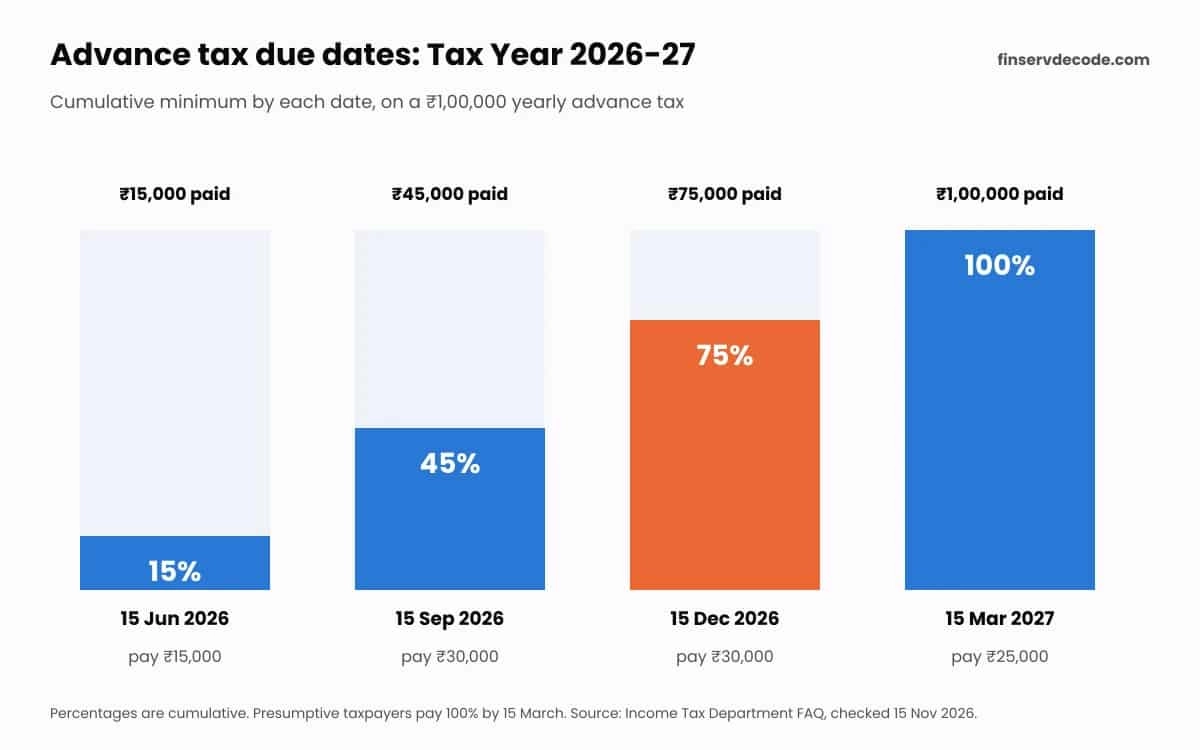
Advance tax due dates for Tax Year 2026-27, with the cumulative amount on a ₹1,00,000 tax bill. Illustrative graphic created by Finserv Decode.
Due Date for Presumptive Taxpayers
If you declare income under the presumptive scheme in section 58(2), there’s only one date: 15 March 2027, for 100% of the tax. If you pay less than 100% by then, interest is 1% for one month on the shortfall.
Can You Pay Advance Tax After 15 March?
Yes. Any tax paid by 31 March is treated as advance tax for that year. Paying between 16 and 31 March can keep you clear of section 424 interest, if it takes you to 90% of your assessed tax.
But it doesn’t remove the shortfall for 15 March, so section 425 interest still applies for one month. After 31 March, the payment becomes self-assessment tax, not advance tax.
What If the Due Date Falls on a Holiday?
If banks are closed on the last day, the department’s FAQ on advance tax says you can pay on the next working day, and no interest is charged for that delay. Online modes work on holidays too, so paying a day or two early avoids the question. A due date is extended only if CBDT announces it.
How to Calculate Advance Tax
To calculate advance tax, estimate your total income for the year and work out the tax at your regime’s rates. Add surcharge (if any) and 4% cess, then subtract any rebate, TDS, and TCS. If the balance is ₹10,000 or more, that’s your advance tax, which you split across the four due dates.
Here’s how to calculate advance tax step by step
- Estimate income from every source for the full year. Count April to March, not just what you’ve received so far: salary, interest, rent, freelance or business profit, capital gains and dividends.
- Subtract the deductions your regime allows. Under the new regime, salaried people get a standard deduction of up to ₹75,000. Many common old-regime deductions aren’t available, though a few specified ones still apply.
- Apply tax rates. Use slab rates for normal income, and special rates for items such as equity capital gains (the rate depends on the asset and how long you held it). Add surcharge if it applies to your income level, then 4% health and education cess.
- Subtract the rebate under section 156, if you qualify. Under the new regime, it’s up to ₹60,000 where total income isn’t more than ₹12 lakh, with marginal relief just above it.
- Subtract TDS and TCS deducted or expected for the year, counting each credit only once.
- Check the ₹10,000 limit. If the balance is ₹10,000 or more, that’s your advance tax. Pay it by the due dates.
Section 405 of the Act puts this into a formula. A simplified version: advance tax = tax on estimated total income (after rebate, with surcharge and cess) − TDS and TCS.
Is There a Separate Advance Tax Slab?
No. There’s no special advance tax slab; you use the normal income tax rates for the year. For Tax Year 2026-27 under the new regime, which is the default, section 202(1) sets these rates:
| Total income | Rate |
|---|---|
| Up to ₹4,00,000 | Nil |
| ₹4,00,001 to ₹8,00,000 | 5% |
| ₹8,00,001 to ₹12,00,000 | 10% |
| ₹12,00,001 to ₹16,00,000 | 15% |
| ₹16,00,001 to ₹20,00,000 | 20% |
| ₹20,00,001 to ₹24,00,000 | 25% |
| Above ₹24,00,000 | 30% |
These are income tax rates. The advance tax percentages (15%, 45%, 75%, 100%) only decide when you pay the tax worked out at these rates.
Resident individuals with total income up to ₹12 lakh get a rebate of up to ₹60,000 under section 156, so tax on their slab-rate income becomes nil. Just above ₹12 lakh, marginal relief applies: the tax payable can’t be more than the income above ₹12 lakh. The rebate doesn’t cover special-rate income such as equity capital gains.
If you’re on the old regime, the old slabs apply. This old vs new tax regime comparison helps you check which one suits you.
Advance Tax Calculation Example for Salaried Employee
Meera, 34, is a resident salaried employee on the new regime. Here are the assumptions for Tax Year 2026-27:
- Salary ₹18,00,000. She hasn’t declared her other income to her employer, so the employer works out TDS on salary only.
- FD interest: ₹1,50,000. Assume the bank deducts TDS of 10% (₹15,000). The actual deduction depends on the bank’s threshold and your PAN details.
- Freelance design work: net profit ₹3,00,000, with no TDS.
- No other income or deductions, and no surcharge applies at this income level.
| Step | Working | Amount |
|---|---|---|
| Salary after standard deduction | ₹18,00,000 − ₹75,000 | ₹17,25,000 |
| Total income | ₹17,25,000 + ₹1,50,000 + ₹3,00,000 | ₹21,75,000 |
| Tax at slab rates | ₹20,000 + ₹40,000 + ₹60,000 + ₹80,000 + ₹43,750 | ₹2,43,750 |
| Add 4% cess | ₹2,43,750 × 4% | ₹9,750 |
| Total tax for the year | - | ₹2,53,500 |
| Employer TDS (tax on ₹17,25,000 plus cess) | ₹1,45,000 + ₹5,800 | ₹1,50,800 |
| Bank TDS on FD interest | 10% of ₹1,50,000 | ₹15,000 |
| Advance tax payable | ₹2,53,500 − ₹1,65,800 | ₹87,700 |
₹87,700 is above ₹10,000, so Meera must pay advance tax in four parts:
| Due date | Cumulative % | Cumulative amount | Pay in this instalment |
|---|---|---|---|
| 15 June 2026 | 15% | ₹13,155 | ₹13,155 |
| 15 September 2026 | 45% | ₹39,465 | ₹26,310 |
| 15 December 2026 | 75% | ₹65,775 | ₹26,310 |
| 15 March 2027 | 100% | ₹87,700 | ₹21,925 |
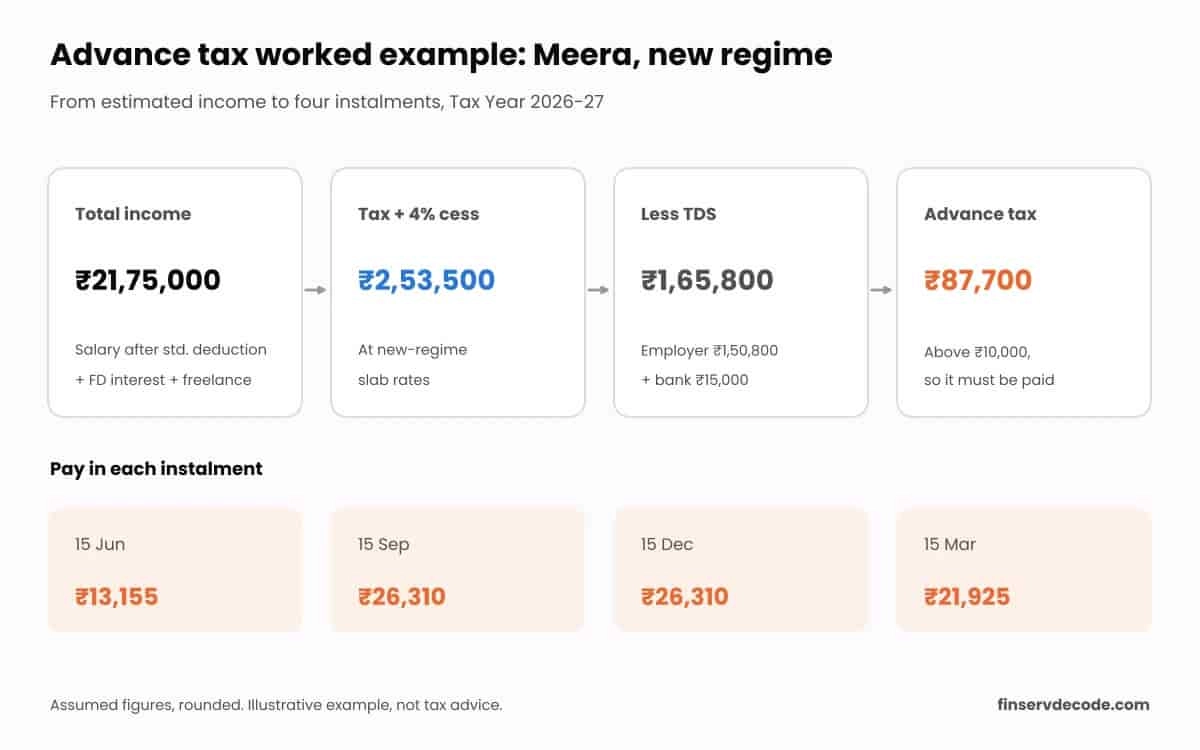
Worked example: from estimated income to four advance tax instalments (new regime, Tax Year 2026-27). Illustrative graphic created by Finserv Decode.
What If There’s No Freelance Income?
Now remove Meera’s freelance income and see what changes:
| Without freelance income | Amount |
|---|---|
| Total income (₹17,25,000 + ₹1,50,000) | ₹18,75,000 |
| Tax with 4% cess | ₹1,82,000 |
| TDS (employer + bank) | ₹1,65,800 |
| Gap | ₹16,200 |
₹16,200 still crosses ₹10,000. That’s because the bank deducts 10% on her FD interest, while her top slab is 20%. So interest income alone can pull a salaried person into advance tax.
Advance Tax on Capital Gains Earned Mid-Year
Capital gains are hard to predict, so the law gives relief. If a gain arises after an instalment date has passed, you pay the tax on it in the remaining instalments, and you aren’t charged section 425 interest for the earlier dates. The department’s FAQs on interest list the same relief for lottery and similar winnings, dividend income, and business or professional income in the year it first starts.
Example: Arjun’s salary TDS covers his salary tax. On 10 October 2026, he redeems units of an equity-oriented mutual fund, on which STT was paid, after holding them for three years. He books a long-term gain of ₹3,25,000 and has no other such gains in the year.
- Gain above the ₹1.25 lakh yearly exemption: ₹2,00,000
- Tax at 12.5% under section 198: ₹25,000
- Add 4% cess: ₹26,000
These rates come from the department’s page on tax in special cases. The ₹26,000 crosses ₹10,000, but the gain came after 15 September, so Arjun owes nothing for June and September. Paying the full ₹26,000 by 15 December 2026 keeps him clear of interest.
A short-term gain on listed equity shares or equity-oriented fund units (STT paid) is taxed at 20% under section 196. So the same gain, held for 12 months or less, would need more tax. Other assets, such as debt funds or property, follow different rates and holding periods.
The timing rule is the same for every asset. If you sell a flat in January 2027 and the tax crosses the ₹10,000 limit, the tax on that gain goes into the 15 March 2027 instalment.
Revising Your Advance Tax Estimate Mid-Year
Your estimate can change during the year. You can revise it and adjust the remaining instalments without filing anything with the department.
If your income turns out higher, top up at the next due date to limit interest. If it’s lower, pay less in the later instalments. Keep a note of each revised estimate and its working, which helps when you file your return.
There’s also some tolerance for the first two dates. Section 425 interest for June and September is charged only if you paid less than 12% of your tax by 15 June, or less than 36% by 15 September.
How to Pay Advance Tax Online
You pay advance tax through the e-Pay Tax service on the Income Tax e-Filing portal. The key choices this year are the Act and the year.
The portal’s e-Pay Tax FAQ says payments for Tax Year 2026-27 onwards fall under the Income Tax Act, 2025. So select that Act and Tax Year 2026-27, not an Assessment Year. Choosing the 1961 Act or AY 2026-27 by mistake can send the credit to the wrong year.
How to Pay Advance Tax Online After Login
- Log in to incometax.gov.in with your PAN and password.
- Go to e-File → e-Pay Tax.
- On the Act selection screen, choose Income Tax Act, 2025 and click Continue.
- Click New Payment, then click Proceed on the Income Tax tile.
- Select Tax Year 2026-27 and Type of Payment: Advance Tax (100). Click Continue.
- Enter the tax break-up (tax, surcharge, cess) and click Continue.
- Pick a payment mode, check the preview, and pay. Download the receipt from Payment History.
Menu labels can change when the portal is updated. But the three selections that matter stay the same: Income Tax Act, 2025, Tax Year 2026-27, and Advance Tax (100).
How to Pay Advance Tax Without Logging In
You can also pay without logging in. Click e-Pay Tax under Quick Links on the portal home page, choose the Act, enter your PAN twice and your mobile number, and verify with OTP. The remaining steps are the same.
Logging in is still better, because it keeps your drafts, generated challans, and payment history in one place.
Advance Tax Payment Modes
The portal’s payment modes guide lists these options:
- Net banking of authorised banks
- Debit card of authorised banks
- Payment gateway: net banking, debit card, credit card and UPI, depending on what the chosen gateway supports
- NEFT/RTGS through a mandate form, which works from any bank
- Pay at bank counter: cash, cheque or DD at selected branches (cash only up to ₹10,000)
The department doesn’t charge a fee. Gateway charges come from the bank or gateway and depend on the mode: UPI is listed as free, while credit card payments carry a percentage fee plus GST. Check the fee on the preview screen before you pay. If you’re paying by card, also check the credit card fees and charges your card issuer may add on top.
Advance Tax Challan: CRN, ITNS 280N and Receipt
Under the 2025 Act, income tax payments use challan ITNS 280N, generated inside e-Pay Tax. The old Challan 280 belonged to the 1961 Act.
When you create a payment, the portal gives you a Challan Reference Number (CRN). A generated challan is valid for 15 days after the CRN is created. For an Advance Tax CRN generated on or after 16 March, the e-Pay Tax FAQ sets validity to 31 March of that year. If a CRN expires, generate a fresh one.
After payment, download the challan receipt from e-File → e-Pay Tax → Payment History. It shows the BSR code, challan number, and payment date, which you’ll need when you file your return.
How to Check Your Advance Tax Payment
- Payment History in e-Pay Tax (after login) lists every paid challan.
- Know Your Payment Status (no login): enter your PAN, CRN, and mobile number, then verify with OTP.
- Form 26AS: the payment appears within 3 to 4 working days, according to the department’s advance tax FAQ.
The time depends on when the bank realises the payment and uploads the challan. If the payment still doesn’t show, first check its status in Payment History. Then contact the bank you paid through, with the CRN, challan number, and BSR code ready.
Interest on Advance Tax: Late or Short Payment
Missing advance tax doesn’t bring a penalty in the usual sense. Instead, two kinds of simple interest apply, both at 1% per month or part of a month. “Part of a month” means even one day counts as a full month.
Section 424 (Old 234B): Paying Less Than 90%
Section 424 applies if you paid no advance tax, or paid less than 90% of your assessed tax by 31 March. Interest runs on the shortfall from 1 April after the tax year until your income is determined or assessed. If you pay self-assessment tax before filing, interest on that part stops from the payment date.
Section 425 (Old 234C): Missing an Instalment
| Due date | Interest applies if paid less than | Interest |
|---|---|---|
| 15 June | 12% of tax | 3% (1% × 3 months) on the shortfall against 15% |
| 15 September | 36% of tax | 3% (1% × 3 months) on the shortfall against 45% |
| 15 December | 75% of tax | 3% (1% × 3 months) on the shortfall against 75% |
| 15 March | 100% of tax | 1% on the shortfall against 100% |
“Tax” here is what the FAQs on interest call assessed tax: tax on your total income, less TDS, TCS, and certain credits, such as foreign tax credit and relief under section 157. For most salaried people and freelancers, that’s simply the tax left after TDS and TCS.
Interest on Advance Tax: Two Examples
Example 1: one missed instalment. Meera (₹87,700 advance tax) pays June and September on time but skips 15 December, then catches up by 15 March. Her shortfall on 15 December is ₹65,775 − ₹39,465 = ₹26,310. Interest under section 425 is ₹26,310 × 3%, or about ₹789.
This assumes she paid June and September in full and on time, and nothing extra before 15 December. She owes no section 424 interest because she paid in full by 31 March.
Example 2: no advance tax at all. Now say Meera paid no advance tax and cleared the full ₹87,700 as self-assessment tax on 20 July 2027:
| Interest | Working | Amount |
|---|---|---|
| Section 425, June | ₹13,155 × 3% | ₹395 |
| Section 425, September | ₹39,465 × 3% | ₹1,184 |
| Section 425, December | ₹65,775 × 3% | ₹1,973 |
| Section 425, March | ₹87,700 × 1% | ₹877 |
| Section 424 | ₹87,700 × 1% × 4 months (April to 20 July) | ₹3,508 |
| Total | - | about ₹7,937 |
These figures are approximate. The department rounds the amount on which interest is calculated, so your exact interest can differ by a few rupees. The cost grows with each month of delay, so catching up at the next due date costs far less than waiting for your return.
What If I Pay Advance Tax One Day Late?
Under section 425, interest on a missed June, September or December instalment is a fixed three months on the shortfall. It’s the same whether you pay one day late or at the next due date.
Paying late still helps, though. It reduces the shortfall at the next date, and it can keep you above 90% for section 424.
Common Advance Tax Mistakes to Avoid
- Selecting the wrong Act or year: choosing the Income Tax Act, 1961 or AY 2026-27 for income earned in Tax Year 2026-27.
- Picking the wrong payment type: choosing Self-Assessment Tax (300) instead of Advance Tax (100) for a payment made before 31 March.
- Missing income in the estimate: leaving out FD interest, rent, dividends, or capital gains.
- Trusting the bank’s TDS: assuming the bank’s 10% TDS covers the tax on interest when your slab is higher.
- Thinking the new regime removes advance tax: it changes your rates, not the instalment rules.
- Not checking the PAN: letting someone else pay for you without checking that the challan shows your PAN.
- Skipping the tax break-up: entering tax, surcharge and cess together. If you missed it, the department’s FAQ says to enter the total in the income-tax column of your return.
- Misreading the percentages: treating 15%, 45%, 75% and 100% as separate instalments instead of cumulative totals.
- Reusing last year’s calculation: not checking this year’s slab rates, rebate, and special-rate rules.
Advance Tax FAQs
Is advance tax applicable under the new tax regime?
Yes. The regime decides your tax rates, while advance tax decides when you pay. If your tax after TDS is ₹10,000 or more under either regime, the instalment rules apply.
What if I pay more advance tax than needed?
Advance tax is credited against your final tax. If TDS, TCS, and advance tax together exceed your final liability, claim the refund in your return. It’s issued after the return is processed.
Can someone else pay my advance tax from their bank account?
Yes. The payment doesn’t have to come from your own account, but the challan must clearly show your PAN. Credit goes to the PAN on the challan, so check it before paying.
Do I need to pay advance tax if TDS covers all my tax?
No. If your tax after TDS and TCS is below ₹10,000 for the year, no advance tax is due. Any small balance is paid as self-assessment tax before you file.
Can I pay advance tax with a credit card?
Yes, through the payment gateway option in e-Pay Tax. Credit card payments carry a gateway fee plus GST, so check the charge on the preview screen first.
What should I do if I get an advance tax order from the department?
The Assessing Officer can send an order by 28 February. If you estimate your tax to be lower than the amount demanded, send your estimate in Form 152 and pay accordingly. If your own estimate is higher, pay according to your estimate; no separate intimation is needed.
Has the 15 December 2026 due date been extended?
As of 15 November 2026, no extension had been announced. Extensions come only through a CBDT announcement, so check the e-Filing portal’s updates before the date.
Conclusion
If your tax for Tax Year 2026-27, after TDS, will be ₹10,000 or more, treat the next due date as your checkpoint. As of this update, that’s 15 December 2026, when 75% of your yearly tax should be paid. Work out your number with the six steps above, add any capital gains booked since September, and pay through e-Pay Tax with the Income Tax Act, 2025 and Tax Year 2026-27 selected.
If you’ve missed an instalment, work out the shortfall now instead of waiting until filing time. Section 425 interest for a missed date is fixed, but paying enough by 31 March can avoid section 424 interest altogether. Keep the challan receipt, and check that the payment appears in Form 26AS.
Disclaimer
This article is only for general information about advance tax under the Income-tax Act, 2025 for Tax Year 2026-27. It isn’t tax, legal, or financial advice. Rules, rates, and portal steps can change, so check the Income Tax Department’s website or consult a chartered accountant for your situation. Actual tax can differ with residential status, income type, deductions, exemptions, tax credits, surcharge and special-rate rules. The examples use assumed figures and are rounded. Sources checked as of now: Tax Payments FAQ, e-Pay Tax FAQs and payment-modes guide (incometax.gov.in, no revision date shown); FAQ on Advance Tax and FAQs on Interest under sections 423–426 (incometaxindia.gov.in, undated, citing the Income-tax Act, 2025); Form 130 FAQs and e-Pay Tax functionality FAQs; text of sections 156, 202 and 403 of the Income-tax Act, 2025.