The full form of HUF is Hindu Undivided Family. In Hindi it is called हिंदू अविभाजित परिवार (Hindu Avibhajit Parivar). An HUF is a joint Hindu family made up of people descended from a common ancestor, along with their wives and daughters. Income tax law treats it as a separate taxpayer. Once formalised, it gets its own PAN, files its own income tax return where filing is required, and pays tax on its own slab rates.
Families mainly consider an HUF for this reason. Income that legally belongs to the HUF, such as rent from a property the HUF owns, is taxed in the HUF’s hands instead of being added to one member’s income. But one rule is easy to miss: an HUF does not get the Section 87A rebate. Under the new regime, an HUF starts paying tax above ₹4 lakh, while a resident individual pays nothing up to ₹12 lakh.
Two more limits matter from the start. Property a person inherits from a parent does not automatically become HUF property. When a member contributes their own money or property to the HUF without adequate consideration, the tax on its income does not shift to the HUF. This guide will explain what an HUF is, who can form one, how the deed, PAN, and bank account work (with sample images from a real application), the current HUF tax slab, when an HUF saves tax and when it does not, and how an HUF is closed.
HUF at a Glance: Quick Answers
| Basic Question | Short Answer |
|---|---|
| What is HUF? | A Hindu joint family that income tax law treats as a separate “person”, with its own PAN and return |
| Who can form one? | Hindu, Jain, Sikh and Buddhist families. One person alone cannot form an HUF |
| Can husband and wife form an HUF? | Yes, a married couple, even without children. It has HUF income only once it owns property, investments or a business |
| Can a salaried person create an HUF? | Yes, but salary can never be moved into the HUF. It stays taxable in the employee’s hands |
| What is the HUF basic exemption limit? | ₹4 lakh under the new regime, ₹2.5 lakh under the old regime. Special-rate income such as some capital gains is taxed under its own rules |
| Does an HUF get the 87A rebate? | No. The rebate is only for resident individuals, so ₹12 lakh is not tax-free for an HUF |
| Is HUF registration needed? | There is no government registration. Families document the HUF with a deed, a PAN and a bank account |
| Which ITR does an HUF file? | ITR-2 (no business income), ITR-3 (business income) or ITR-4 (eligible presumptive income) for AY 2026-27 |
| How do I spot an HUF PAN? | The 4th character of the PAN is “H” |
What Is HUF? Meaning of Hindu Undivided Family
The Income Tax Department describes an HUF as a family that “consists of all persons lineally descended from a common ancestor”, including their wives and unmarried daughters. Since the 2005 amendment to the Hindu Succession Act, a married daughter also stays a coparcener in her father’s HUF. The Department also says an HUF cannot be created by a contract. Under Hindu law, it arises on its own in a Hindu family, and you do not register it with any government office. Being taxed as an HUF is a separate question: that depends on the family having joint family property and income of its own.
For tax purposes, the HUF is a “person” separate from its members. It can own property, run a business, hold investments, open bank and demat accounts, and file its own income tax return. Its income is assessed separately from the personal income of the Karta and the members. In legal and tax writing, it is also called a joint Hindu family.
So the HUF meaning in income tax is simple: it is a family-level taxpayer. You have your own PAN and return. Your HUF has another PAN and another return. Income that belongs to the family goes into the HUF’s return, and income you earn yourself stays in yours.
An example: Ramesh, his wife Sunita, their son Amit and daughter Neha together form “Ramesh HUF”. Ramesh is the Karta, Amit and Neha are coparceners, and Sunita is a member. Rent from a flat that Ramesh HUF bought with its own funds belongs to Ramesh HUF. The salary Amit earns from his job is his own. Whether a house Ramesh inherited from his father belongs to the HUF depends on how it came to him, which is explained further below.
HUF Full Form in Tax, Banking and Business
| Where You See “HUF” | What It Means |
|---|---|
| Income tax, ITR and TDS | Hindu Undivided Family, a taxpayer status like Individual, Firm or Company |
| PAN card | The 4th character “H” marks the PAN holder as an HUF |
| Banking (SBI, HDFC and others) | A savings or current account in the HUF’s name, run by the Karta |
| Business | A business owned and run by the HUF, with profits taxed in the HUF’s hands |
| Hindi | हिंदू अविभाजित परिवार (Hindu Avibhajit Parivar) |
| Currency markets | Unrelated: “HUF” is also the code for the Hungarian forint |
Why Is an HUF Created?
Legally, an HUF is not “created” by a decision. It arises from birth and marriage in a Hindu family. What families actually do is formalise it for tax and banking: they write a declaration (the HUF deed), get a PAN, and open a bank account. They usually do this when there is income that belongs to the family as a unit, such as property that is already joint family property, a family business, or the HUF’s own investments.
Is HUF Registration Required?
No. There is no registration office or certificate for an HUF. When people search for “HUF registration”, they usually mean the three practical steps: the deed, the PAN, and the bank account. These documents help banks and the tax department recognise the HUF. They do not, by themselves, prove that a particular property belongs to the HUF.
What Are the Two Types of HUF?
The two types usually meant are the two schools of Hindu law:
- Mitakshara: Followed in most of India. Children get a share in coparcenary property by birth.
- Dayabhaga: Traditionally followed in West Bengal and Assam. Broadly, children do not get a right in the property by birth; rights arise on the father’s death.
Tax rules are the same for both. The school affects who holds what share when the family property is divided. This is a simplified picture: local custom, state amendments, and the facts of each family also matter, so a property dispute needs a lawyer’s view.
Features of a Hindu Undivided Family
- It comes into being by birth and marriage, not by a contract or registration.
- It is headed by the Karta, who manages its affairs.
- It has coparceners (who get a share by birth) and members (who join by marriage).
- It is taxed as a separate “person” with its own PAN, return, slab rates, and deduction limits.
- It continues across generations. The Karta’s death does not end it; the next senior coparcener usually takes over.
- For tax, it ends only on a total partition that the tax officer records.
Is There a Hindu Undivided Family Act? Laws That Govern an HUF
Many people search for the “Hindu Undivided Family Act” or an “HUF Act PDF”. There is no separate Act by that name. Two sets of rules apply instead:
- Hindu law (personal law): Decides who belongs to the family, who is a coparcener, and who becomes Karta. The key statute is the Hindu Succession Act, 1956. It applies to Hindus and also to Buddhists, Jains, and Sikhs. Its 2005 amendment made daughters coparceners by birth, the same as sons.
- Income tax law: Treats the HUF as a separate taxpayer and sets its slabs, deductions, clubbing rules, and partition rules. From 1 April 2026, this is the Income-tax Act, 2025, which replaced the Income-tax Act, 1961.
Because of the new Act, the familiar section numbers have changed. These are the ones that matter most for an HUF:
| Rule | Income-tax Act, 1961 | Income-tax Act, 2025 |
|---|---|---|
| New tax regime slabs | Section 115BAC | Section 202 |
| Rebate (resident individuals only) | Section 87A | Section 156 |
| Clubbing when a member puts own property into the HUF | Section 64(2) | Section 99(3) |
| Assessment after partition | Section 171 | Section 315 |
| Tax audit | Section 44AB | Section 63 |
| Life insurance, ELSS and similar deductions | Section 80C | Section 123 |
| Health insurance deduction | Section 80D | Section 126 |
Returns for FY 2025-26 (AY 2026-27) still follow the 1961 Act. Income earned from 1 April 2026 falls under the 2025 Act, where a single “Tax Year” replaces the previous year and assessment year. How the Tax Year under the new Act works is worth knowing before you file for 2026-27.
Who Can Form an HUF? Eligibility Rules
An HUF is open to Hindus, Jains, Sikhs and Buddhists. The Hindu Succession Act, 1956 covers all four, and the Income Tax Department treats Jain and Sikh families as HUFs for tax. Muslim, Christian and Parsi families cannot form an HUF, because their personal laws do not have this joint-family structure.
You need at least two people; one person alone cannot be an HUF. The Income Tax Department lists family groups whose ancestral-property income is taxed as HUF income. They show how small an HUF can be:
- A widowed mother and her sons
- A husband and wife with no children
- Two widows of deceased brothers
- Two or more brothers
- An uncle and a nephew
- A mother, her son and the son’s wife
- A male member and his late brother’s wife
To assess income as HUF income, the Department looks for two things: a coparcenary and joint family property (ancestral property, property bought with its help, or property put into the family by members).
Can Husband and Wife Form an HUF?
Yes. The Income Tax Department lists a husband and wife with no children among families whose joint family property income is taxed as an HUF. The husband is usually the Karta, though this is a common practice rather than a fixed rule for every family. Children born later become coparceners. But marriage alone gives the HUF nothing to report. It has HUF income only once it owns property, investments, or a business of its own. Opening a bank account in the HUF’s name does not change that.
Can an Unmarried Person Create an HUF?
No, not an HUF of their own. An unmarried son or daughter is already a coparcener in the father’s HUF. A person usually forms a separate HUF after marriage.
Can an NRI Be the Karta?
Yes. An NRI can be the Karta. What changes is the HUF’s tax residence. Under Section 6(9) of the Income-tax Act, 2025, an HUF is resident in India unless the control and management of its affairs is situated wholly outside India.
HUF Members: Who Is the Karta, a Coparcener, and a Member?
This is the basic HUF structure: every HUF has three kinds of people. The difference matters for rights, partition, and who can run the HUF.
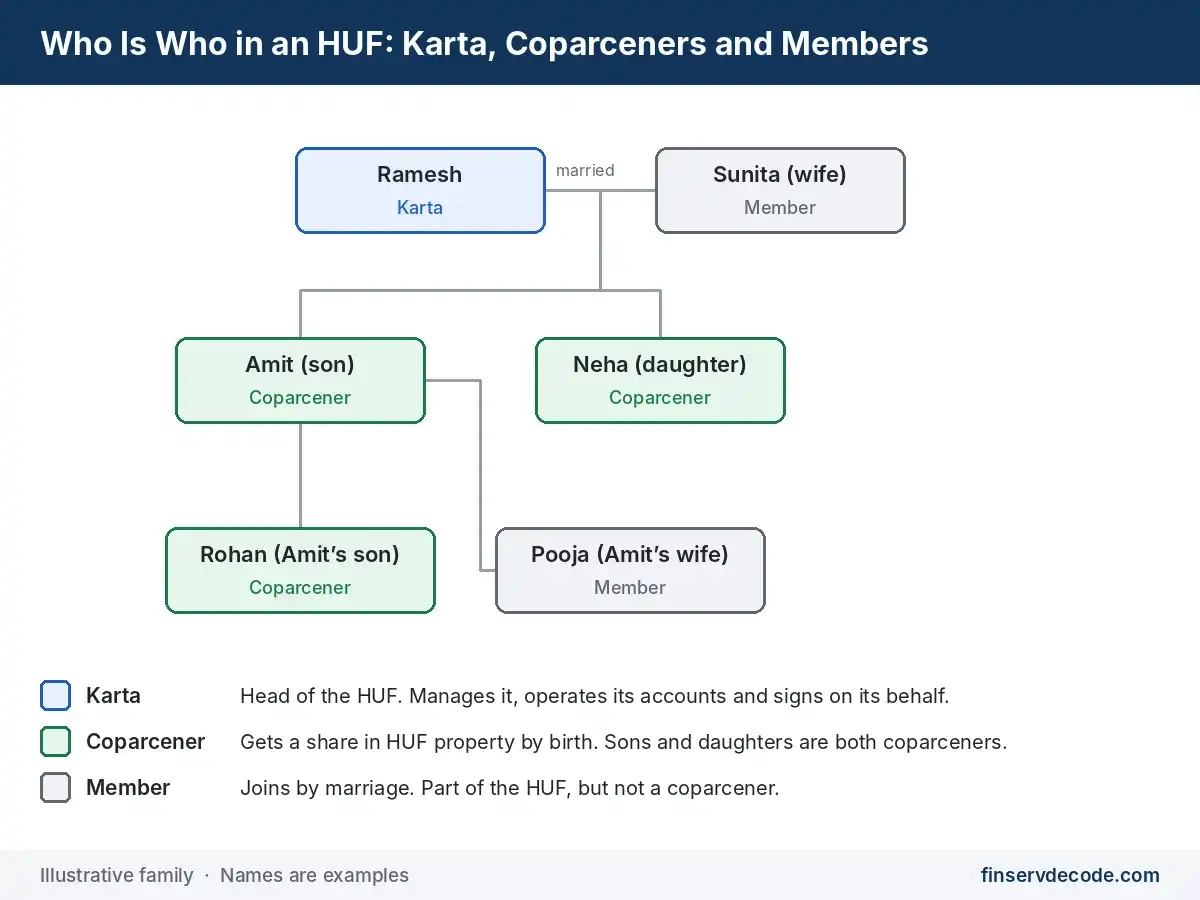
Who Is a Coparcener? Coparcener Meaning in Law
A coparcener is someone who gets an interest in the joint family property by birth. In a Mitakshara family, this traditionally covers the lineal descendants of the family head up to four generations, including the head. Since the Hindu Succession (Amendment) Act, 2005, daughters are coparceners by birth, with the same rights as sons. In Vineeta Sharma v. Rakesh Sharma (2020), the Supreme Court held that this applies even if the father died before the amendment came into force on 9 September 2005.
A coparcener can ask for partition and gets a share in the property when it is divided.
Difference Between a Coparcener and a Member of an HUF
| Point | Coparcener | Member |
|---|---|---|
| How they join | By birth (sons, daughters and grandchildren in the line) | By marriage (wives of coparceners) |
| Share in HUF property | Yes, by birth | No share by birth; rights such as maintenance depend on personal law |
| Can ask for partition? | Yes | No, not as a coparcener |
| Can become Karta? | Yes (the senior-most coparcener usually is) | Generally no, as per the Supreme Court’s view in Seth Govindram Sugar Mills |
| Example | Son, daughter, son’s son | Karta’s wife, son’s wife |
Is a Wife a Coparcener?
No. A wife becomes a member of her husband’s HUF on marriage, but she is not a coparcener in it. A married daughter, on the other hand, stays a coparcener in her father’s HUF and also becomes a member of her husband’s HUF.
What Is the Difference Between Karta and Coparcener?
The Karta is the person who manages the HUF. Under the usual Mitakshara rules, the Karta is a coparcener, normally the senior-most one, but not every coparcener is the Karta. The Karta operates the bank account, makes investments, signs documents, deals with the tax department, and signs the HUF’s return. Other coparceners have ownership rights, but day-to-day control sits with the Karta.
Can a Woman Be the Karta of an HUF?
A daughter can. In Sujata Sharma v. Manu Gupta (2015), the Delhi High Court held that the eldest daughter, being a coparcener after the 2005 amendment, can be the Karta of her father’s HUF.
A wife or widow is in a different position, because she joins the family by marriage and is not a coparcener in it. In CIT v. Seth Govindram Sugar Mills, the Supreme Court held that a mother could not act as Karta for this reason, though she can act as guardian of minor coparceners. The answer can depend on the facts and on later case law, so take a lawyer’s view before naming a wife or widow as Karta in any document, especially if family members disagree.
What Happens If the Karta Dies?
The HUF does not end when the Karta dies. Usually the next senior-most coparcener takes over as Karta, and that can be a daughter, though the family’s facts and the law decide who can act. Banks and investment platforms will need the new Karta’s details and KYC. The HUF’s PAN stays the same.
Is There a Limit on HUF Members?
There is no fixed maximum. In a Mitakshara family, a child born into the line becomes a coparcener by birth, and a marriage adds a member. The minimum is two people. Not every relative has the same rights, so check each person’s position before any property decision.
How to Create an HUF in 4 Steps
Since an HUF already exists by law, “creating” one means putting the paperwork in place so that banks, investment platforms, and the tax department recognise it.
Step 1: Prepare the HUF Deed (Format and Stamp Paper)
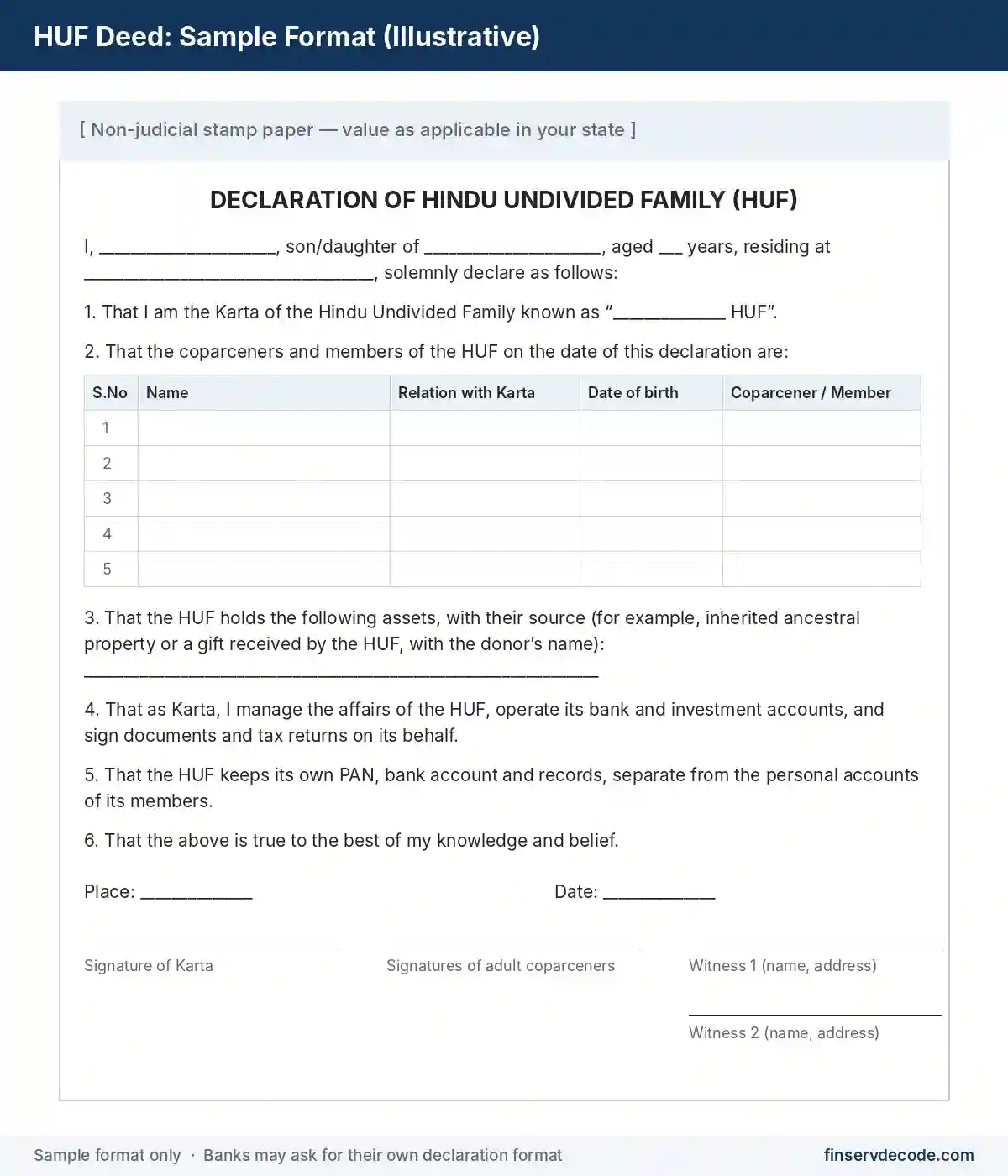
An HUF deed is a written declaration by the Karta. It records the HUF’s name, the Karta, the coparceners and members, and the assets the HUF holds. The law does not require a deed for an HUF to exist, but banks and PAN agencies usually ask for one.
A typical HUF deed format covers:
- Name of the HUF, usually written as “[Karta’s name] HUF”
- Karta’s name, father’s name, age, and address
- A table of coparceners and members with their relation to the Karta and date of birth
- The assets of the HUF and their source, such as property that is already joint family property or a gift received by the HUF (with the donor’s name)
- A statement that the Karta manages the HUF and operates its accounts
- Place, date, signatures of the Karta and adult coparceners, and two witnesses
The deed is usually made on non-judicial stamp paper. The stamp value, and whether notarisation is needed, depend on your state and your bank, so check locally. Treat any sample as a starting point. A declaration made for PAN or banking does not replace a registered document where property law needs one, and it does not turn a member’s personal property into HUF property.
Note: Do not fund the HUF with the Karta’s own savings to “start” it. Under Section 99(3) of the Income-tax Act, 2025 (Section 64(2) of the 1961 Act), income from a member’s own property put into the HUF without adequate consideration is taxed back in that member’s hands. The HUF saves nothing on it.
Step 2: Apply for an HUF PAN Card
An HUF needs its own PAN to file returns, open bank and demat accounts, and invest in its own name. The Karta applies for it. Under the Income-tax Rules, 2026, the PAN application form for an HUF is Form 94. It replaced the older Form 49A. As per the Department’s PAN Forms 93 to 96 FAQ, an HUF has to submit proof of identity, proof of address, and proof of its date of formation, along with an affidavit giving details of the members.
How to Apply for an HUF PAN Card Online and Charges
- Go to the PAN service of Protean or UTIITSL and choose the form for Indian non-individual applicants.
- Select the status “Hindu Undivided Family”, not “Individual”.
- Enter the HUF’s name in the format “[Karta’s name] HUF”. On the older Form 49A, the applicant ticked the title “M/s”. Use the matching option on the current form.
- Enter the HUF’s date of formation where the form asks for the date of birth or incorporation.
- Fill in the Karta’s details and the HUF’s source of income.
- Upload or send the documents: the proofs and the affidavit listing the members. The Karta signs in the capacity of Karta.
- Pay the fee and note the acknowledgement number.
| PAN Option | Fee (Including Taxes) |
|---|---|
| Physical PAN card, dispatched in India | ₹107 |
| e-PAN only, online paperless mode (e-KYC and e-Sign) | ₹66 |
| e-PAN only, through a TIN Facilitation Centre or PAN centre | ₹72 |
PAN fees as listed in the Income Tax Department’s Forms 93–96 FAQ (checked as of now). Fees can change, so confirm the amount on the PAN service provider’s payment page before you pay.
HUF Affidavit for PAN: What It Contains
The Income Tax Department’s PAN FAQ asks an HUF to submit an affidavit giving details of its members. In practice, the Karta signs this declaration on non-judicial stamp paper. It lists the HUF’s name, every coparcener with their father’s name and address, and the date from which the HUF has existed.
The image below is a real affidavit used for an HUF PAN application in September 2025, with all personal details hidden. This one was made on ₹10 stamp paper and notarised. Stamp paper value and notarisation rules vary by state, so check with your PAN centre or a local notary before preparing yours.
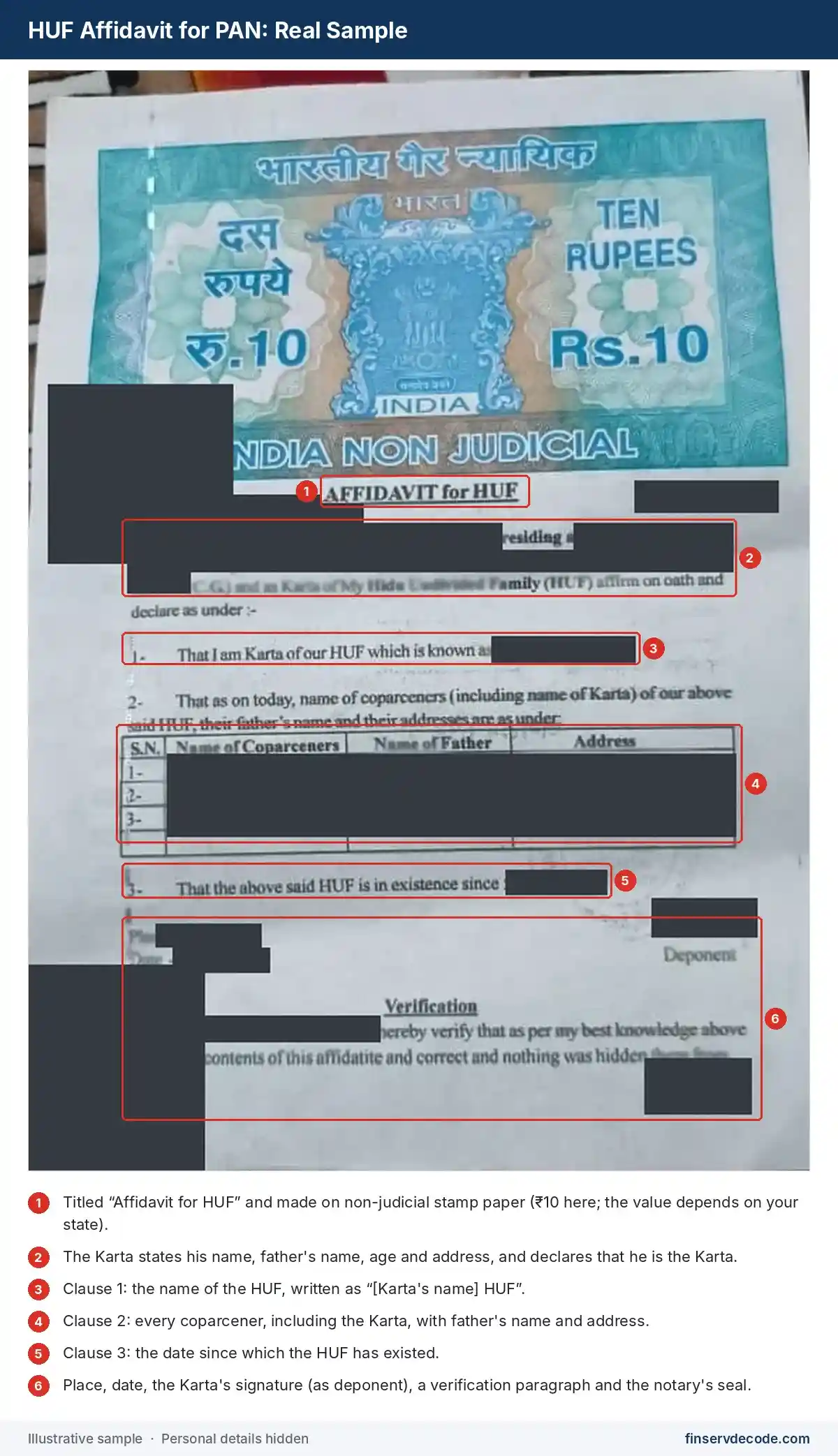
List every coparcener on the date you sign, including the Karta and daughters, who have been coparceners by birth since the 2005 amendment. Keep a copy, because banks often ask for the same affidavit or a similar declaration when you open the HUF account.
The images below come from a real HUF PAN application filed in September 2025 on the older Form 49A, with personal details hidden. Form 94 may label or order fields differently, so follow the current form’s instructions. Use these images to see what each part asks for.
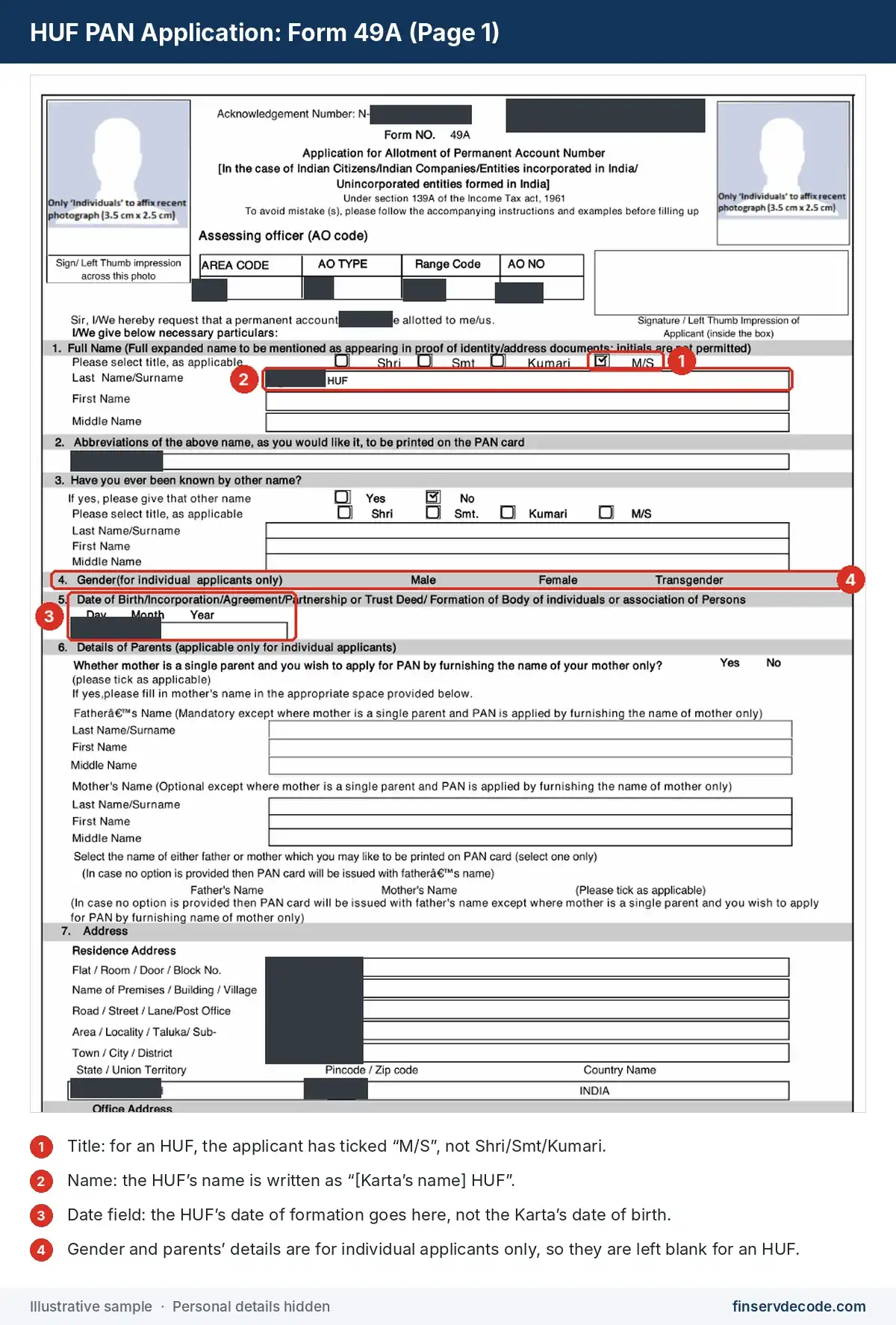
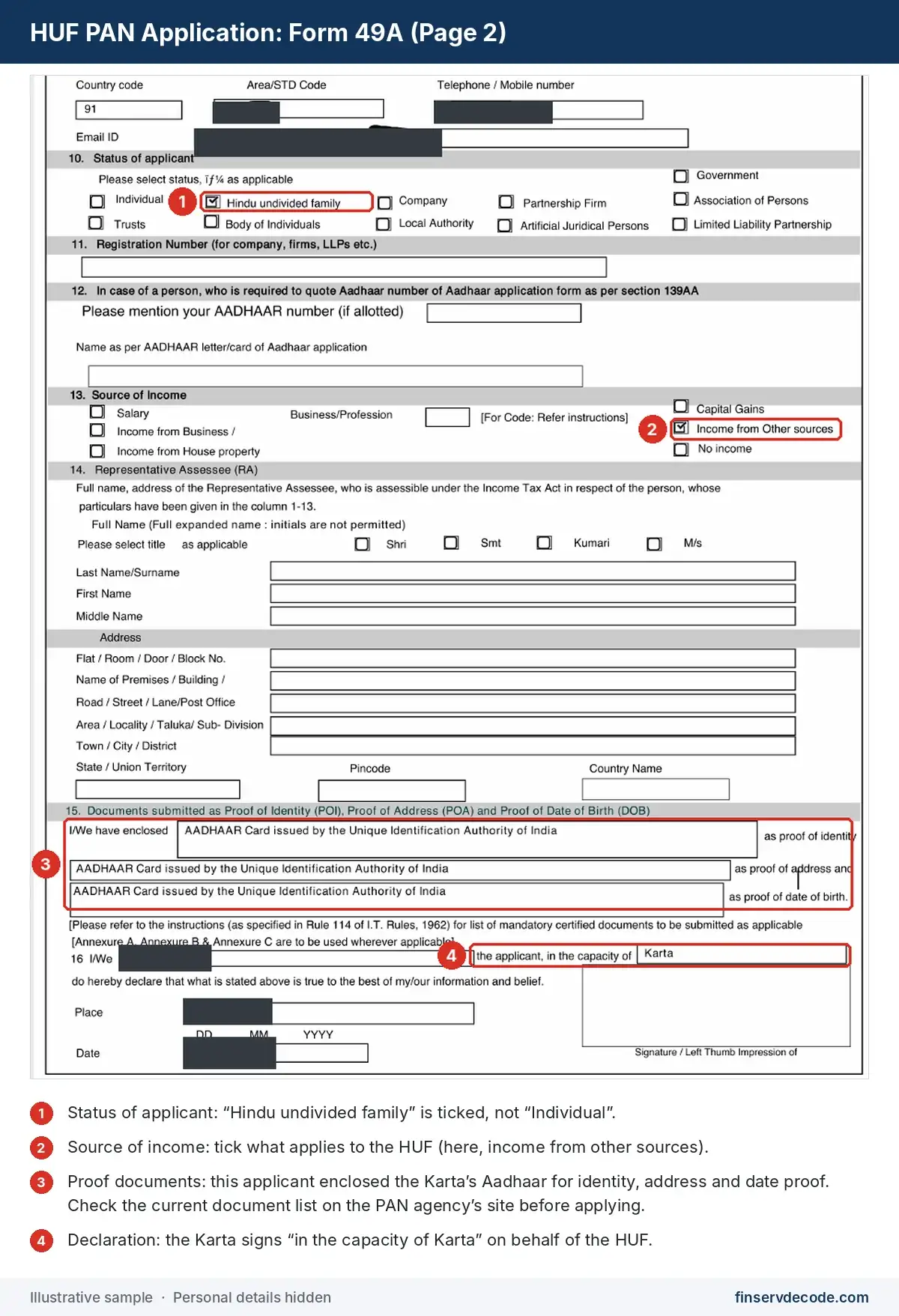
After you apply, the PAN agency updates you by email: first that it received your documents, then that they are in order, and finally the PAN with the e-PAN attached. In the application shown here, the whole process took about two weeks. Timelines vary.

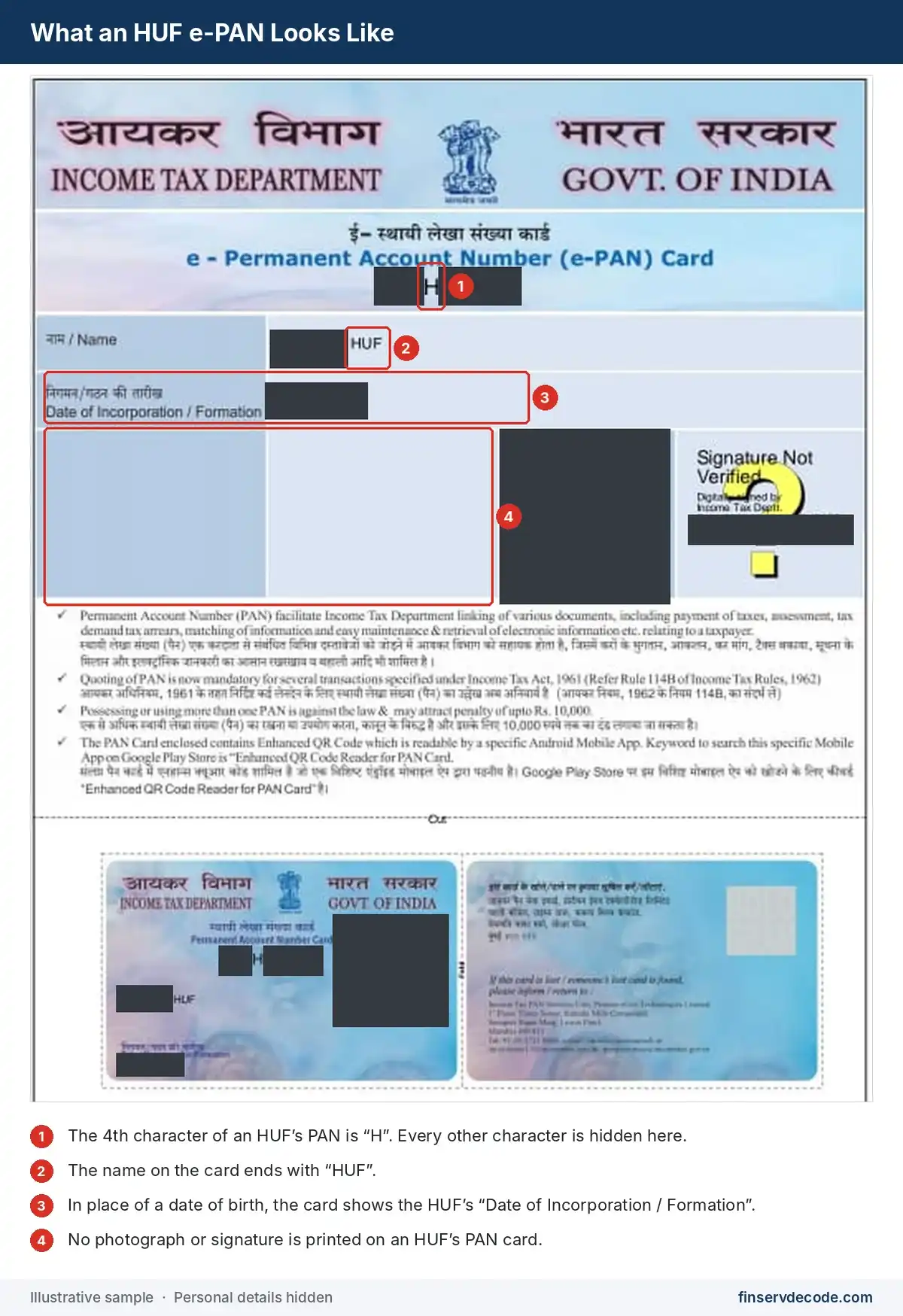
What Does an HUF PAN Card Look Like? (The 4th Letter)
You can tell an HUF PAN card at a glance. The 4th character of the PAN is “H”, the name ends with “HUF”, and the card shows a “Date of Incorporation / Formation” instead of a date of birth. There is no photograph or signature on it.
Step 3: Open an HUF Bank Account
An HUF account is a bank account in the HUF’s name, operated by the Karta or by others the bank’s mandate allows. Its main benefit is a clean money trail that keeps family income separate from personal income. All HUF income comes into it, and all HUF spending and investments go out of it. Most large banks offer HUF savings and current accounts.
Documents banks commonly ask for:
- HUF PAN card
- HUF deed, or the bank’s own HUF declaration form
- Karta’s PAN, Aadhaar, and photographs (KYC)
- Names of coparceners and members, often with their signatures
- Proof of the HUF’s address
The exact list varies by bank, so check its HUF account page or ask the branch. When signing for the HUF, the Karta usually signs above a stamp that reads “For [Name] HUF”, with “Karta” below the signature. Banks and people often call this the “HUF Karta stamp”.
Step 4: Build HUF Capital the Right Way
An HUF with no assets has nothing to tax and nothing to save. Its capital should come from sources that truly belong to the family: property that is already joint family property, an inheritance left to the HUF under a will, gifts from people who are not members (taxable above the ₹50,000 limits explained below), and income from the HUF’s own business or investments.
How Can an HUF Earn Money? Valid Sources of HUF Income
| Source | Is It HUF Income? |
|---|---|
| Rent from joint family property | Yes, if the property legally belongs to the HUF. Property inherited individually from a parent is not automatically HUF property (see below) |
| Property or investments bought with HUF money | Yes, along with the interest, dividends, rent and capital gains they earn |
| A business run by the HUF | Yes. Profits are taxed in the HUF’s hands |
| Inheritance or a bequest to the HUF under a will | Yes, and money received under a will or by inheritance is not taxed as a gift |
| Gifts from members | Not taxed as a gift. But if a member transfers their own property to the HUF without adequate consideration, its income is clubbed back to that member |
| Money gifted by non-members (friends, the wife’s relatives) | Yes. If money gifts from non-members cross ₹50,000 in the year, the whole amount is taxable income of the HUF |
| Property gifted by non-members (land, a flat, shares, jewellery) | Yes, under separate ₹50,000 tests based on stamp duty value or fair market value, explained below the table |
| Salary of the Karta or any member | Generally no. Salary for a member’s personal employment is the member’s own income (special cases are covered below) |
| Fees for a member’s personal skill (doctor, CA, lawyer) | No. Professional income from personal skill stays with the individual |
The gift rules come from the Department’s page on tax treatment of gifts received by an individual or HUF. For an HUF, a “relative” means any member of the HUF, so gifts from members are not taxed as income. For gifts from anyone else, the page sets three separate tests:
- Money (cash, cheque, bank transfer): taxable if the year’s total from non-members exceeds ₹50,000. Once the limit is crossed, the entire amount is taxed, not just the excess.
- Land or a building: taxable if the stamp duty value of the property exceeds ₹50,000. The whole stamp duty value is then taxed.
- Specified movable property (shares and securities, jewellery, bullion, paintings and other art, virtual digital assets): taxable if their total fair market value received in the year exceeds ₹50,000. Items outside this list, such as a car, are not covered by these rules.
Money or property received under a will or by inheritance is not taxed under these rules. The marriage-gift exemption is written for “the individual”, so do not count on it for the HUF.
Does Inherited (Ancestral) Property Belong to the HUF?
Not automatically, and this is where many families go wrong.
The Income Tax Department’s HUF page describes ancestral property as property inherited from the father, grandfather, or great-grandfather. But the Supreme Court has held that when a father dies without a will, and his property passes to his son under Section 8 of the Hindu Succession Act, 1956, the son takes it in his individual capacity, not as Karta of his own HUF.
His children get no right in it by birth. This was laid down in CWT v. Chander Sen (1986) and followed in Yudhishter v. Ashok Kumar (1987). In Darubai v. Kamalabai (2026), the Supreme Court applied the same rule: heirs under Section 8 hold separate shares, and one heir cannot sell the others’ shares by acting as “Karta”.
| How the Property Came to the Family | Usual Position |
|---|---|
| Already joint family (coparcenary) property, still held by the existing HUF | HUF property |
| Bought with HUF funds | HUF property |
| Left to the HUF by name in a will | HUF property |
| Father’s separate property, inherited by a child under Section 8 without a will | Individual property of each heir, not HUF property |
| A member’s own property put into the HUF without adequate consideration | Becomes family property, but its income is clubbed back to that member |
So before showing rent from an inherited house in the HUF’s return, check the property’s history: how the father held it, whether there was a will, and how it was split among the heirs. If you are unsure, ask a lawyer or CA before filing.
Can an HUF Earn a Salary?
Not in the usual sense. An HUF is not an employee, and a member’s salary for personal work is the member’s income. Courts have, however, treated some payments as HUF income where they were earned mainly because of HUF funds, for example, fees from a directorship that came through the HUF’s shareholding. This depends on the facts of each case.
The reverse also exists. An HUF that runs a business can pay a reasonable salary to a member who works in that business. That salary is a business expense for the HUF and taxable income for the member.
Can I Withdraw Money From My HUF?
Yes. Money a member receives out of the HUF’s income is not taxed again in the member’s hands, because the HUF has already paid tax on it. Under the Income-tax Act, 2025, this exemption is in Serial No. 1 of Schedule III (Section 10(2) of the 1961 Act). It does not cover income that is clubbed back to a member under Section 99(3) or 99(4). Record each withdrawal in the HUF’s books.
How Is an HUF Taxed? HUF Meaning in Income Tax and ITR
When you see “HUF” in an ITR, it is a status, like Individual or Firm. In both PAN and ITR forms, an HUF has its own category, separate from Individual. An HUF’s income is worked out under the same heads as an individual’s (house property, business, capital gains, and other sources), but in its own return and under its own PAN. The basic rules of how income tax works in India apply to it in the same way.
- Separate slab ladder: the HUF gets its own basic exemption and slab rates.
- Separate deductions: under the old regime, the HUF claims its own 80C, 80D and other eligible deductions.
- Residence: depends on where control and management sit, not on where members live.
- Continuity: once assessed as an HUF, it stays one until a total partition is recorded.
HUF Tax Slab: New and Old Regime
The HUF tax slab is the same as the slab for an individual below 60. Senior-citizen slabs never apply to an HUF. The slabs below match the Income Tax Department’s HUF page for AY 2026-27.
HUF Tax Slab New Regime and Old Regime: FY 2025-26 (AY 2026-27) and Tax Year 2026-27
| New Regime (Default) | Tax Rate | Old Regime | Tax Rate |
|---|---|---|---|
| Up to ₹4,00,000 | Nil | Up to ₹2,50,000 | Nil |
| ₹4,00,001 to ₹8,00,000 | 5% | ₹2,50,001 to ₹5,00,000 | 5% |
| ₹8,00,001 to ₹12,00,000 | 10% | ₹5,00,001 to ₹10,00,000 | 20% |
| ₹12,00,001 to ₹16,00,000 | 15% | Above ₹10,00,000 | 30% |
| ₹16,00,001 to ₹20,00,000 | 20% | - | - |
| ₹20,00,001 to ₹24,00,000 | 25% | - | - |
| Above ₹24,00,000 | 30% | - | - |
The HUF tax slab new regime rates are the default unless the HUF opts out. For Tax Year 2026-27, Section 202 of the Income-tax Act, 2025 carries the same new regime slabs. Budget 2026 did not change the slab rates.
A 4% Health and Education Cess is added to the tax. Surcharge applies above ₹50 lakh: 10% up to ₹1 crore, 15% up to ₹2 crore, and 25% above that. Above ₹5 crore, it is 37% under the old regime, while the new regime caps it at 25%.
Does an HUF get the 87A rebate, or is ₹7 Lakh or ₹12 Lakh Tax-Free?
No. The 87A rebate for HUF is not available. The rebate in Section 156 of the Income-tax Act, 2025 (Section 87A of the 1961 Act) is only for “an individual resident in India”. An HUF is not an individual, so it does not get the ₹60,000 rebate that makes income up to ₹12 lakh tax-free for individuals in the new regime. The same applies to the older ₹7 lakh limit and the old regime’s ₹5 lakh limit.
Here is what this means in rupees:
| Total Income | HUF Tax (New Regime) | Resident Individual, Same Income (New Regime) | HUF Tax (Old Regime, No Deductions) |
|---|---|---|---|
| ₹4 lakh | ₹0 | ₹0 | ₹7,800 |
| ₹5 lakh | ₹5,200 | ₹0 | ₹13,000 |
| ₹8 lakh | ₹20,800 | ₹0 | ₹75,400 |
| ₹10 lakh | ₹41,600 | ₹0 | ₹1,17,000 |
| ₹12 lakh | ₹62,400 | ₹0 | ₹1,79,400 |
| ₹15 lakh | ₹1,09,200 | ₹1,09,200 | ₹2,73,000 |
All figures include 4% cess and assume no other income or deductions. The individual column assumes non-salary income, with no standard deduction.
How Much HUF Income Is Tax-Free?
The basic exemption limit for an HUF is ₹4 lakh under the new regime and ₹2.5 lakh under the old regime. Under the old regime, deductions such as 80C and 80D can raise the amount that goes untaxed.
Which Deductions Can an HUF Claim?
| Deduction | Allowed to HUF? | Tax Regime |
|---|---|---|
| 80C (life insurance on members, ELSS, home loan principal, 5-year tax-saving FD) | Yes, up to ₹1.5 lakh | Old |
| 80D health insurance for members | Yes: ₹25,000 (₹50,000 if the insured member is a senior citizen) | Old |
| 80DD and 80DDB (disabled member, specified illness) | Yes | Old |
| 80G, 80GGA and 80GGC (donations) | Yes, subject to their conditions | Old |
| 80TTA savings account interest | Yes, up to ₹10,000 | Old |
| Home loan interest, self-occupied house | Yes, up to ₹2 lakh | Old |
| Home loan interest, let-out house | Yes (in the new regime, a loss from house property cannot be set off against other income) | Both |
| 30% standard deduction on rent | Yes | Both |
| New PPF account | No, closed to HUFs since 13 May 2005 | Not applicable |
| NPS (80CCD), 80TTB, 80E, 80U and 80GG | No, these are for individuals only | Not applicable |
| Standard deduction on salary | No, an HUF has no salary income | Not applicable |
The list follows the deductions the Income Tax Department shows for HUFs for AY 2026-27. In the Income-tax Act, 2025, these deductions carry new section numbers; for example, 80C is now Section 123 and 80D is now Section 126.
Can an HUF Choose the New or Old Regime? Switching Rules
Yes. The new regime is the default for an HUF, and an HUF can opt for the old regime instead. How often it can switch depends on its income:
- No business income: the choice is made in the return each year, filed by the due date.
- Business or professional income, AY 2026-27 (1961 Act): opting out of the new regime needs Form 10-IEA, filed by the due date. After that, the HUF can come back to the new regime only once.
- Tax Year 2026-27 onwards (2025 Act): Section 202 carries a similar option for businesses. Check the form number the e-filing portal shows for your year before you file.
The old and new tax regime comparison covers how to weigh deductions against lower rates.
HUF Benefits and Tax Calculation: How Much Can a Family Save?
The main HUF benefits come from one fact: income that belongs to the HUF is taxed on a separate slab ladder, instead of on top of a member’s own income. The saving is largest when that member is already in a high slab. The examples below are illustrative, and the working is shown.
Example 1: Rent From a Property the HUF Owns (Where an HUF Helps)
An HUF owns a house that is legally HUF property, bought years ago with HUF funds. It is let out for ₹30,000 a month (₹3.6 lakh a year). The Karta has taxable business income of exactly ₹20 lakh, has no other adjustments, and uses the new regime.
- Taxable rent after the 30% standard deduction: ₹3.6 lakh − ₹1.08 lakh = ₹2.52 lakh.
- If the Karta wrongly adds the full ₹2.52 lakh to his own income, it sits above ₹20 lakh and falls in the 25% slab: ₹2.52 lakh × 25% = ₹63,000, plus 4% cess = ₹65,520 extra tax.
- Shown correctly in the HUF’s return, ₹2.52 lakh is below the HUF’s ₹4 lakh nil slab: ₹0 tax.
- Difference: ₹65,520 a year, simply from reporting the HUF’s income in the HUF’s return.
This does not mean you should move a personally owned property into an HUF. If you transfer it without adequate consideration, its income is clubbed back to you.
Example 2: HUF With ₹10 Lakh Income (Which Regime Costs Less)
This example assumes the deductions are eligible and paid from HUF funds. An HUF earns ₹10 lakh from rent and interest. It pays ₹1.5 lakh in life insurance premiums for members (80C) and ₹25,000 in health insurance (80D).
- New regime: tax on ₹10 lakh = ₹41,600.
- Old regime: taxable income ₹8.25 lakh, tax = ₹80,600.
- For this HUF, the new regime costs ₹39,000 less.
In this example, the old regime catches up only when total deductions reach about ₹3.6 lakh. That figure is for ₹10 lakh of income with no other adjustments; at other income levels, the break-even point changes. An HUF usually reaches it only if it also pays interest on a home loan for a self-occupied house.
Example 3: Where an HUF Does Not Help
Take ₹6 lakh of FD interest. If it legally belongs to a family member with no other income, the 87A rebate covers it, and the tax is ₹0. If the same ₹6 lakh is the HUF’s income, the tax is ₹10,400. Separate HUF taxation is not automatically cheaper. And income can never be moved or relabelled just to get a lower rate.
- When an HUF makes sense: the family has income that legally belongs to the HUF (HUF property, an HUF business, HUF investments), and the members who would otherwise report it are in high slabs.
- When it does not: the income is small, the members earn below ₹12 lakh, or the only way to fund the HUF is a member’s own money given without adequate consideration.
HUF for Salaried Person: Can a Salaried Employee Create an HUF?
Yes. An HUF for a salaried person is allowed. Being salaried does not stop you from forming an HUF after marriage or applying for its PAN. But salary itself can never go into the HUF. It stays on your Form 16 and in your own return.
A salaried person benefits from an HUF only when the HUF has its own income, for example:
- Income from property that legally belongs to the HUF (check how the property was inherited)
- An inheritance or bequest made to the HUF in a relative’s will
- Gifts to the HUF from non-members, keeping in mind the ₹50,000 limits on money and property gifts
- Returns on the HUF’s own investments, once it has capital from these sources
What does not work: transferring part of your salary or savings to the HUF account without adequate consideration. Income from that money is clubbed back to you under Section 99(3) of the 2025 Act.
HUF vs Individual: Key Differences
| Point | HUF | Individual |
|---|---|---|
| Basic exemption (new / old regime) | ₹4 lakh / ₹2.5 lakh | ₹4 lakh / ₹2.5 lakh (higher for seniors in the old regime) |
| 87A rebate | Not available | Available to residents (up to ₹12 lakh income in the new regime) |
| Standard deduction | Not available | Available on salary and pension |
| Senior-citizen slabs | Never apply | Apply at 60 and 80 |
| Income it can have | Family property, HUF business, HUF investments | Salary, profession, own investments |
| PAN | 4th letter “H” | 4th letter “P” |
| Who signs | Karta | The individual |
| How it ends | Total partition | Not applicable |
Advantages and Disadvantages of HUF
Here are the HUF advantages:
- A separate slab ladder and separate deductions for income that belongs to the family
- Family property stays together and is managed by one person
- Continues after the Karta’s death, with the next senior coparcener taking over
- Members are not taxed again on money they receive out of the HUF’s income
- Can hold investments, run a business, and take loans in its own name
Here are the HUF disadvantages:
- No 87A rebate: the HUF pays tax above ₹4 lakh even when an individual would pay nothing.
- Funding is hard: a member’s own money put into the HUF without adequate consideration brings clubbing, and gifts from non-members above the ₹50,000 limits are taxed.
- Every child in the line becomes a coparcener (Mitakshara): a newborn gets a share by birth, and any coparcener can ask for partition.
- The Karta’s power: one person controls the money, which can lead to disputes. In an HUF business, the Karta’s liability is generally not limited.
- Hard to close: only a total partition ends the HUF for tax. A partial partition is ignored.
- Extra compliance: a separate PAN, bank account, and books, plus its own return whenever filing is required.
HUF ITR Filing: Form, Due Date and Audit
The HUF files its own return under its own PAN, and the Karta signs and verifies it. The Department’s HUF filing guide shows the portal steps.
| HUF Situation (AY 2026-27) | ITR Form |
|---|---|
| No business or professional income (rent, interest, capital gains) | ITR-2 |
| Business or professional income | ITR-3 |
| Resident HUF, total income up to ₹50 lakh, eligible presumptive business income (and the form’s other conditions met) | ITR-4 (Sugam) |
- Due date for AY 2026-27: 31 July 2026 for HUFs filing ITR-2, and 31 August 2026 for HUFs with business income that do not need an audit (ITR-3 or ITR-4), as the Income Tax Department announced. Audit cases get a later date. Both dates have passed, so an HUF that missed them can file a belated return by 31 December 2026, with the late fee and interest. For later years, check the dates on the e-filing portal.
- Late fee: for returns under the 1961 Act, ₹5,000, or ₹1,000 if total income is up to ₹5 lakh, as per the Department’s penalties page.
- Tax audit: needed if the HUF’s business turnover exceeds ₹1 crore (₹10 crore if cash receipts and cash payments are each within 5%), or its professional receipts exceed ₹50 lakh. Under the 2025 Act, this is Section 63.
- Form 15G: an eligible resident HUF can give Form 15G to its bank to avoid TDS on interest, if the tax on its estimated total income for the year is nil and the form’s other conditions are met.
- ITR-1 is never for an HUF. It is only for individuals.
HUF Partition: How to Close an HUF
An HUF partition is the only way to end an HUF: all its property is divided among the coparceners. Under Section 315 of the Income-tax Act, 2025 (Section 171 of the 1961 Act):
- An HUF that has been assessed as one continues to be treated as an HUF until the tax officer records a finding of partition after an inquiry.
- Partition means a physical division of the property. Splitting only the income, or just living separately, does not count.
- A partial partition made after 31 December 1978 is ignored, and the family stays taxable as an HUF.
- Members stay jointly and severally liable for the HUF’s taxes for the period before partition.
A distribution of capital assets on an HUF partition is generally not treated as a transfer for capital gains, so no capital gains tax usually arises at that point. When a coparcener later sells the property, the gain is worked out under the cost and holding-period rules that apply to assets received on partition, which generally look back to the HUF’s cost and holding. The exact result depends on the property and the facts, so take a CA’s advice before selling. A partition deed and its stamp duty follow state law, so take local legal advice too.
Common HUF Mistakes and How to Avoid Them
- Putting salary or professional fees into the HUF account. This income generally stays with the individual and will be added back.
- Funding the HUF with the Karta’s own savings. If the money goes in without adequate consideration, income from it is clubbed back to the Karta.
- Treating inherited property as HUF property without checking. Property inherited from a father under Section 8 without a will is usually the heir’s own property.
- Assuming ₹12 lakh is tax-free for the HUF. The 87A rebate does not apply.
- Opening a new PPF account for the HUF. Not allowed since 13 May 2005, as the RBI notice on HUF PPF accounts explains.
- Mixing personal and HUF money. Keep a separate account, books, and records.
- Filing ITR-1 or choosing “Individual” status. Use ITR-2, ITR-3 or ITR-4 with HUF status.
- Believing a partial partition ends the HUF. For tax, only a recorded total partition does.
Frequently Asked Questions About HUF
What is HUF in simple words?
An HUF is a Hindu joint family that tax law treats as a separate taxpayer. It has its own PAN and files its own return where filing is required, separate from its members.
What is the full form of HUF in Hindi and in banking?
HUF stands for Hindu Undivided Family, or हिंदू अविभाजित परिवार (Hindu Avibhajit Parivar) in Hindi. The full form is the same in banking, where an HUF account is a savings or current account in the family’s name that the Karta operates.
Can husband and wife form an HUF?
Yes. A married couple, even without children, can be an HUF, with the husband usually as Karta. It has HUF income only once it owns property, investments, or a business of its own.
How many members are needed for an HUF?
At least two. There is no upper limit. Children and spouses join automatically by birth and marriage.
Is ₹7 lakh or ₹12 lakh income tax-free for an HUF?
No. The 87A rebate that makes this income tax-free for individuals is not available to an HUF. Under the new regime, an HUF pays tax on income above ₹4 lakh.
What is the HUF tax slab in the new regime?
Nil up to ₹4 lakh, then 5%, 10%, 15%, 20% and 25% for each next ₹4 lakh, and 30% above ₹24 lakh, plus 4% cess.
Is registration required to form an HUF?
No. An HUF arises by birth and marriage. Families make a deed, get a PAN, and open a bank account so that banks and the tax department recognise it.
Can an HUF open a PPF account?
No. New PPF accounts in an HUF’s name have not been allowed since 13 May 2005. Older HUF accounts could run only until maturity.
Can an HUF invest in mutual funds, shares and FDs?
Yes. An HUF can hold a demat account, mutual funds, shares, bonds and fixed deposits in its own name, using its own PAN and bank account.
Can one person be part of two HUFs?
Yes. A married son is a coparcener in his father’s HUF and the Karta of his own HUF at the same time. A married daughter stays a coparcener in her father’s HUF and becomes a member of her husband’s HUF.
Can I transfer my FD to my HUF?
You can, but if you transfer it without adequate consideration, the interest will generally still be taxed in your hands. Under Section 99(3) of the 2025 Act (Section 64(2) of the 1961 Act), income from a member’s own property transferred to the HUF without adequate consideration is clubbed back to that member.
Is a gift to an HUF taxable?
Gifts from members are not taxed as gifts. Money gifts from non-members are taxable in full if the year’s total exceeds ₹50,000, and gifts of property have their own ₹50,000 tests. Money or property received under a will or by inheritance is not taxed.
Does an HUF need GST registration?
Only if the HUF runs a business, or lets out commercial property, and its turnover crosses the GST registration limit. Its GST registration is separate from the Karta’s.
Can an HUF take a loan?
Yes. Banks lend to HUFs against HUF income and assets, usually with the Karta and adult coparceners signing the documents.
How long does it take to get an HUF PAN?
It depends on the agency and on document checks. In the sample application shown in this article, the e-PAN arrived about two weeks after the form was filed.
Conclusion
An HUF, or Hindu Undivided Family, is a family unit recognised under Hindu law that is taxed separately when the tax conditions are met, mainly joint family property and income of its own. Documenting it with a deed, a PAN, and a bank account, and keeping its money apart from members’ money, lets income that truly belongs to the family be taxed on its own slab ladder.
It works well for property that is legally HUF property, for family businesses and for the HUF’s own investments, especially when members are in high slabs. It does not work for salary, for money moved from a member’s own pocket without adequate consideration, or for small incomes, because an HUF gets no 87A rebate. Work out the tax for both the HUF and the individual before deciding, and have a CA check the deed and the source of the HUF’s capital.
Disclaimer: This article is for general information only and is not tax or legal advice. Tax slabs, rebates, section numbers, due dates, and forms are based on the Income-tax Act, 1961 (for FY 2025-26) and the Income-tax Act, 2025 (from Tax Year 2026-27), as shown on official government pages as of now, and can change through future Finance Acts and notifications. Examples are illustrative, use simplified figures, and do not cover every deduction or surcharge. Rules on who can be Karta, on inherited property, on gifts and on partition come from the Act, court decisions and personal law, and they depend on the facts of each family. The sample PAN and deed images are for illustration only, with personal details hidden. Please consult a Chartered Accountant or lawyer before forming, funding, or partitioning an HUF.