
Your salary arrives, rent and bills go out, daily spending follows, and by month-end there’s little left to save. If this happens every month, the problem may be less about how much you earn and more about when you save. The fix is simple. If you’re wondering how to save money from salary, decide the amount in advance, move it to a separate account soon after payday, and plan your bills and spending around what remains. Once this becomes a routine, saving stops depending on willpower.
This guide, written for salaried persons, covers how much of your salary to aim to save, a salary-day system you can set up in one evening, and 12 practical ways to cut monthly leaks. You’ll also find budget examples for ₹10,000, ₹15,000, ₹20,000, ₹30,000 and ₹50,000 take-home salaries, where to keep the money, and the mistakes that undo savings. It works whether you’ve just received your first salary or have been working for years without much to show for it.
How Much of Your Salary Should You Save?
A practical target is around 20% of your take-home salary. But starting at 5–15% is fine if rent, family support, or debt leave less room. What matters more than the starting number is saving the same amount every month and raising it with every pay rise.
There’s no official answer to what percentage of salary should be saved. These are common guidelines:
| Your situation | Savings rate to aim for | Why |
|---|---|---|
| First job, high rent, or supporting family | 10–15% of take-home pay | Builds the habit without cutting essentials |
| Stable job, needs under control | 20% | The savings share in the 50/30/20 rule |
| Saving for a major goal (home down payment, higher studies) | 30% or more | Shortens the time to reach the goal |
| Living with parents, no rent | 40–50% is possible | Few fixed costs; the best years to build savings |
Calculate the percentage on your take-home pay, which is the amount credited to your bank account. Don’t use your CTC, because it includes employer contributions and benefits you don’t receive as monthly cash.
And a high savings rate should never come at the cost of essentials or missed loan payments. If you want a full spending framework, the 50/30/20 rule shows how to split needs, wants, and savings, and when to adjust the ratio.
How to Save Money From Salary: The Salary-Day System
This system decides where your money goes before everyday spending begins. It’s the simplest answer to how to save money each month: set it up once, and it repeats on its own.
- List your fixed bills first. Write down rent, EMIs, insurance premiums, and utilities, with their due dates. These must always be covered.
- Choose a savings amount you can keep up. Pick an amount you can manage every month, even if it’s only ₹500 or 5% of your take-home pay.
- Open a separate savings account. Don’t use it for daily payments. Keep your emergency fund and near-term money here. A recurring deposit suits a planned goal. A SIP is an investment for long-term goals, not a place for emergency money.
- Schedule an automatic transfer. Set a standing instruction in net banking or your bank app for salary day or the next working day. Make sure enough stays behind for bills due that month.
- Pay fixed bills by auto-debit. Keep a small buffer so no payment bounces.
- Treat what’s left as your spending money. If you prefer a weekly limit, divide it by four.
- Check once a week for five minutes. See what’s left and which bills are still to come. If one category runs over, cut another want instead of touching your savings.
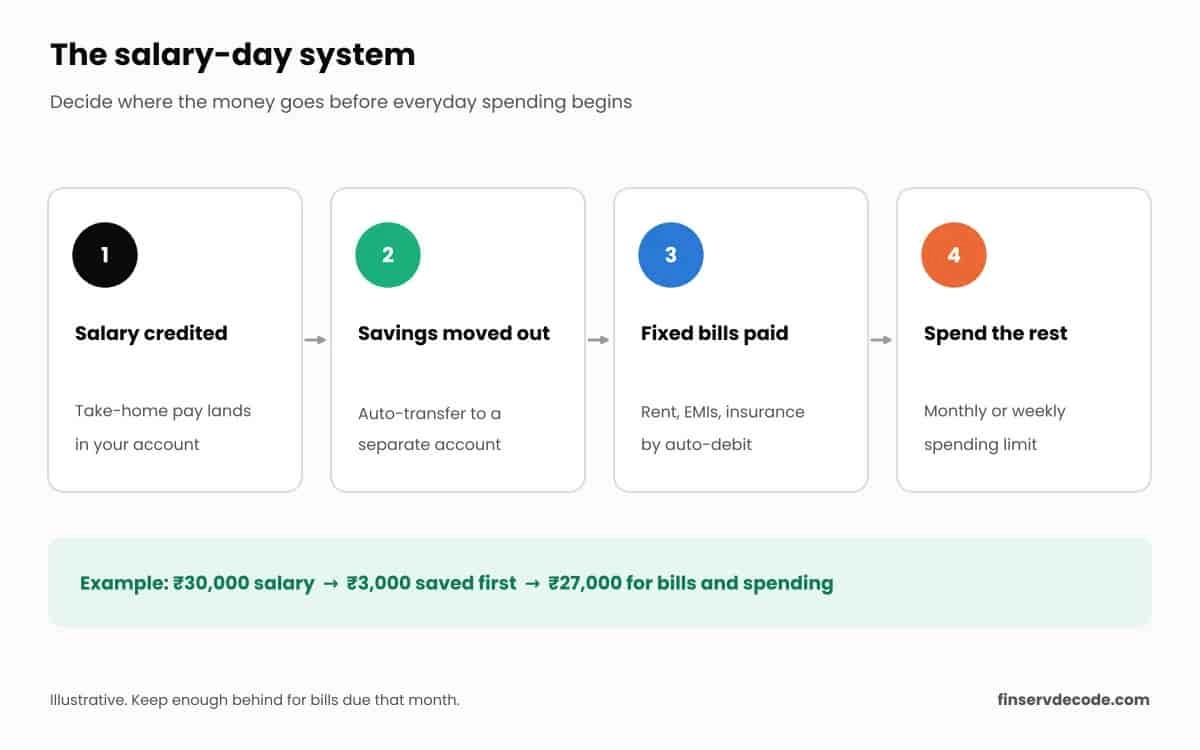
A salary-day system separates savings, fixed bills, and monthly spending before everyday expenses begin. Illustrative graphic created by Finserv Decode.
12 Ways to Save Money From Salary Every Month
These tips on how to save money from your salary work best one at a time. Start with the first two, then add the rest as they become habits.
1. Pay Yourself First
Pay yourself first means treating savings like a bill that you pay before any other spending. It’s the idea behind the salary-day system above.
For example, say you take home ₹30,000 and your savings target is ₹3,000. The ₹3,000 transfer goes out first, and the remaining ₹27,000 covers your bills and spending.
2. Track Every Spend for 30 Days
For one month, note every payment, including small UPI transfers. You may find small, frequent payments that add up over the month: snacks, delivery fees, impulse buys, and forgotten subscriptions.
At the end of the month, group your bank and UPI statement entries into food, travel, bills, shopping, and subscriptions. Then pick the two categories you can realistically cut.
3. Audit Subscriptions and Auto-Debits
List every recurring charge on your card, bank account, and UPI mandates: streaming, music, cloud storage, apps, gym memberships. Review them every few months, and cancel the ones you no longer use.
Choose an annual plan only when you’re sure you’ll keep using the service and the yearly price is lower than paying monthly.
4. Use the 24-Hour and 30-Day Rules
These are spending-control habits, not official rules. For a small non-essential purchase, wait 24 hours. For an expensive item you don’t urgently need, follow the 30-day rule to save money: wait 30 days and use the time to compare prices.
If you still want it after the wait and it fits your wants and budget, go ahead and buy it.
5. Cut Food Delivery and Plan Groceries
Delivery fees, packaging charges, and higher menu prices usually make ordered food costlier than cooking at home. Set a weekly food-delivery budget before the week starts, plan your meals, and buy groceries with a list.
6. Cut Commute Costs
Compare a monthly metro or bus pass, shared rides, or carpooling with what you spend on daily cabs or autos. Choose the option that’s practical and safe for your route and working hours.
7. Right-Size Your Phone, Internet and Utility Bills
Check whether you actually use your mobile plan’s data. A cheaper plan or a family plan often covers the same need.
For electricity, switch off appliances at the plug, use LED lights, and keep the AC at a moderate temperature.
8. Avoid Unnecessary EMIs and Buy Now, Pay Later
An EMI makes an expensive purchase look affordable because you see only the monthly amount. But it commits part of your future salary.
Before you choose an EMI or pay-later option, check the total payable, interest, processing fee, and late charges. Avoid borrowing for non-essential purchases if the EMI would squeeze your essentials or regular savings.
9. Pay the Full Credit Card Bill
If you pay only part of your bill, the unpaid balance attracts finance charges. Depending on your card’s terms, new purchases may also lose the interest-free period.
If you’ve been paying only the minimum, read how the credit card minimum due works before your next bill. Then set an auto-debit for the total amount due, not the minimum.
10. Save Part of Every Raise and Bonus
Lifestyle inflation is when your spending rises every time your income does, so your savings stay flat. When your pay rises, send part of the increase to savings before you raise your regular spending. Do the same with bonuses after any planned expenses.
Once your emergency fund is in place and you invest through a SIP, a step-up SIP raises your investment automatically each year.
11. Create a Sinking Fund for Yearly Costs
Insurance premiums, school fees, festival spending, vehicle servicing, and travel come once or twice a year, and they wreck the month they land in.
Add up these yearly costs, divide the total by 12, and set that amount aside every month in a separate account. When the bill arrives, the money is already there. For example, a ₹12,000 yearly premium needs ₹1,000 a month.
12. Try the 3 Jar Method
The 3-jar method splits your money into three “jars”: spending, saving, and giving (or goals). It started as a way to teach children about money, but it works for adults too, with three bank accounts or wallets instead of jars.
The spending jar covers regular monthly costs. The saving jar builds your emergency fund and short-term goals. The third jar can be for giving, family support, or a personal goal. There’s no fixed percentage for any jar.
How to Save Money From Salary: Plans for ₹10,000 to ₹50,000
Monthly Savings Targets by Take-Home Salary
Here’s a realistic starting point and a target to grow into, based on monthly take-home pay:
| Take-home salary | Start with | Grow into | In a year at the target |
|---|---|---|---|
| ₹10,000 | ₹500 (5%) | ₹1,000 (10%) | ₹12,000 |
| ₹15,000 | ₹1,500 (10%) | ₹2,250 (15%) | ₹27,000 |
| ₹20,000 | ₹2,000 (10%) | ₹4,000 (20%) | ₹48,000 |
| ₹30,000 | ₹4,500 (15%) | ₹6,000 (20%) | ₹72,000 |
| ₹50,000 | ₹10,000 (20%) | ₹15,000 (30%) | ₹1,80,000 |
The yearly figure is 12 monthly contributions at the target. It doesn’t include interest or returns. If you pay full rent alone in an expensive city or support family members, start at the lower number and move up after each raise.
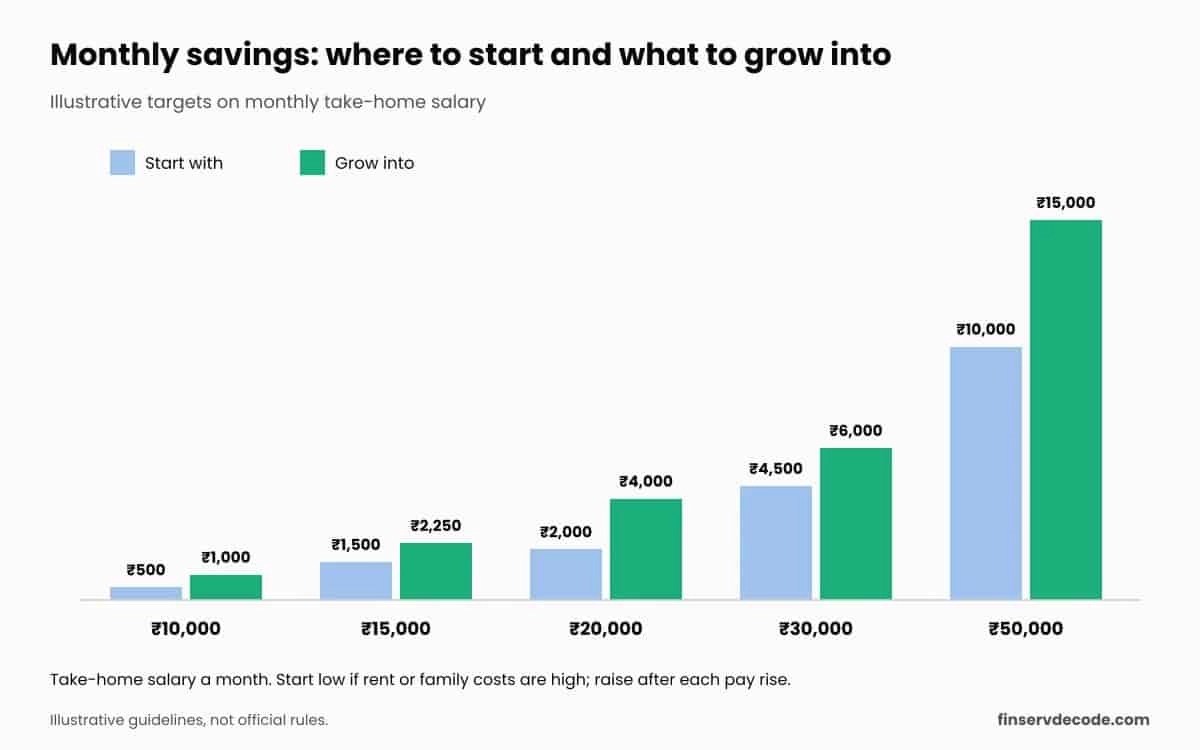
Illustrative starting and target monthly savings at different take-home salary levels. Illustrative graphic created by Finserv Decode.
Example Monthly Budgets by Salary
These budgets are illustrative, and each one assumes a different living situation. Your rent, city, and family responsibilities will change the numbers, so use them as a template, not a rule.
| Item | ₹10,000 | ₹15,000 | ₹20,000 | ₹30,000 | ₹50,000 |
|---|---|---|---|---|---|
| Living situation | With family | Shared room | Shared flat | Small rented flat | Rented flat, big city |
| Rent or home contribution | ₹3,000 | ₹4,000 | ₹6,000 | ₹9,000 | ₹14,000 |
| Food and groceries | ₹1,200 | ₹3,500 | ₹4,500 | ₹5,500 | ₹7,000 |
| Commute | ₹1,500 | ₹1,500 | ₹1,500 | ₹2,000 | ₹3,000 |
| Phone and internet | ₹300 | ₹500 | ₹500 | ₹700 | ₹1,000 |
| Utilities and personal care | ₹1,000 | ₹1,000 | ₹1,500 | ₹1,800 | ₹2,000 |
| Insurance and yearly-cost fund | – | – | – | ₹1,500 | ₹3,500 |
| Wants (outings, shopping) | ₹2,000 | ₹2,250 | ₹3,000 | ₹3,500 | ₹9,500 |
| Savings | ₹1,000 (10%) | ₹2,250 (15%) | ₹3,000 (15%) | ₹6,000 (20%) | ₹10,000 (20%) |
Saving on a ₹10,000, ₹15,000 or ₹20,000 Salary
At these salaries, rent decides most of what’s possible. In the examples, rent or home contribution takes ₹3,000 to ₹6,000, which is 27–30% of pay. That’s why sharing a room or living with family makes the biggest difference at lower salaries.
So whether you’re saving on a ₹10,000, ₹15,000, or ₹20,000 salary, start by fixing your housing cost. Then automate even a small amount, like the ₹1,000 to ₹3,000 shown here.
Saving on a ₹30,000 or ₹50,000 Salary
From ₹30,000 upwards, there’s room to set aside money every month for insurance and yearly costs. This keeps your savings line from being raided when a premium or fee comes due.
On a ₹30,000 salary, the example shows ₹6,000 (20%) in savings plus ₹1,500 for yearly costs. At ₹50,000, the savings and yearly-cost lines together come to ₹13,500.
How to Save Money With a Low Salary
When rent, food, commute, and family support take most of your salary, you don’t need to force a 20% target. Saving should never mean skipping food, healthcare, or other essentials. Try these steps instead:
- Start small and automate. Begin with any fixed amount, even ₹200–₹500. At this stage, the habit matters more than the amount.
- Cut one high cost before many small ones. Sharing a room or moving closer to work can save more than months of skipped coffees.
- Build a small emergency fund first. That way, a medical bill or phone repair doesn’t push you onto a credit card or an informal loan.
- Don’t borrow for routine spending. Using cards, pay-later, or informal loans for daily needs makes your next salary harder to manage.
- Add income where practical. Overtime, a new skill, or suitable extra work can help, but don’t count on the money until you’ve earned it.
- Raise savings step by step. When you get a raise or cut a regular cost, move part of the difference to savings.
If you want to save money fast on a low income, there’s no shortcut. The quickest gains usually come from cutting one high cost, such as rent or a costly EMI. And if your essential costs already exceed your take-home pay, focus first on reducing a major cost or increasing your income. Set a savings target after that.
Where to Keep the Money You Save
Knowing how to save money from salary is only half the job. You also have to keep it where you won’t spend it, and where it fits the goal.
| Purpose | Possible place | What to check |
|---|---|---|
| Emergency fund | Separate savings account or an easy-access deposit such as a sweep-in FD | Access within a day; stability over returns |
| Short-term goals (1–3 years) | Savings account, RD or FD | Maturity date, premature withdrawal rules and charges |
| Long-term growth goals | Diversified investments, including mutual funds | Market-linked; value can fall in the short term |
| Retirement | EPF, PPF, NPS or other retirement options | Lock-in, withdrawal and tax rules before contributing |
Don’t send your entire monthly savings to investments automatically. Money you’ll need soon belongs in an accessible, lower-risk place. Long-term investments should match your time horizon and your ability to handle market swings. EPF and NPS are retirement products, so don’t count them as money available for short-term needs.
If you’re choosing between a recurring deposit and a SIP, this SIP vs RD comparison explains fixed returns versus market-linked growth.
Is Your Saved Money Safe in a Bank?
If you save money from your salary in a bank, your deposits are protected by deposit insurance. According to the DICGC guide, savings, fixed, current, and recurring deposits are insured up to ₹5 lakh per depositor per insured bank, including both principal and interest.
Deposits in different branches or account types of the same bank, held in the same right and capacity, are added together for this ₹5 lakh limit. Deposits in separate insured banks are covered separately.
Tax-Saving Investments and Your Salary Savings
Tax-saving investments should fit your goals, not just your tax calculation. The new tax regime is now the default. Under it, most deductions from the old regime don’t apply, including investments traditionally claimed under Section 80C, such as ELSS, PPF, and life insurance.
So before you buy a product only to save tax, compare your tax under both regimes, and check the product’s lock-in, risk, and liquidity. This comparison of the old and new tax regime explains the main differences.
Mistakes That Stop You From Saving From Salary
- Saving what’s left at month-end instead of on salary day.
- Keeping savings in your salary account, where UPI and card payments can easily reach it.
- Ignoring yearly costs, so every premium or fee becomes an “emergency”.
- Upgrading your lifestyle with every raise while your savings stay at the same rupee amount.
- Putting emergency money in market-linked products, then having to sell when markets are down.
- Missing loan or card payments. These lead to late fees, extra interest, and negative entries on your credit report. Keep due dates in your calendar and enough balance for scheduled payments.
That last mistake costs more than the late fee. Here’s how a missed EMI affects your CIBIL score, and why it matters for future loans.
How to Save Money From Salary: FAQs
How can I save ₹1 lakh in a year from my salary?
Save about ₹8,334 a month. That’s 20% of a ₹41,670 take-home salary, or 30% of about ₹27,800. To do it in 6 months, you’d need about ₹16,667 a month, which usually means cutting wants sharply, using a bonus, or adding income. These figures exclude interest or returns.
How can I save ₹10,000 every month?
₹10,000 is 20% of a ₹50,000 take-home salary, or 30% of about ₹33,330. On a lower salary, combine a fixed transfer on salary day with cutting one high cost and adding income. Don’t pick ₹10,000 just because it sounds good; first make sure your essentials and EMIs are covered without borrowing.
What should I do with my first salary?
List your regular expenses, set up a manageable salary-day transfer from your first salary, and build an emergency reserve gradually. Check whether your employer’s health cover is enough for you, and avoid new EMIs until you know your real monthly costs.
Is saving 50% of salary good?
It’s a very high savings rate, and it’s good only if it doesn’t mean skipping essentials such as health cover, nutrition, or skills. It’s realistic mainly when you have no rent or few dependants. For many salaried earners, 20–30% is a sustainable range.
Is it fine to keep savings in my salary account?
It’s better to move them out. Money in your salary account is easy to spend through UPI and cards, while a separate savings account, RD, or FD makes it clear which money is off-limits. A separate account helps you stay organised, but it doesn’t by itself earn more or make the money safer.
What is the difference between saving and investing?
Saving keeps money safe and available, usually in a bank, for short-term needs and emergencies. Investing puts money into assets such as mutual funds or shares, which can grow faster over many years but can also fall in value. Keep emergency and near-term money in savings first, and invest the rest for long-term goals once high-interest debt is under control.
Conclusion
The answer to how to save money from salary is simple: decide the amount once, move it out on salary day, and live on the rest. Start at whatever percentage your situation allows, even 5–10%, aim for 20%, and raise it with every increment instead of upgrading your lifestyle.
The 12 ways in this guide work best one at a time. Set up the salary-day transfer this month, track your spending for 30 days, then cut the biggest leak you find. Small, automatic steps add up faster than big resolutions. And once your emergency fund is ready, this guide on how to invest in mutual funds online can help you start your first SIP for long-term goals.
Disclaimer
This article is for general information and education only. It isn’t financial, tax, or investment advice. Savings rates and budgets are guidelines, and the right amounts depend on your income, expenses, dependants, and goals. We took deposit insurance details from the DICGC website, and the details are checked as of now. Examples are illustrative and don’t guarantee any savings or returns. Please consult a qualified adviser for decisions specific to your situation.