EMI bounce charges are the fee your lender adds when an EMI auto-debit fails. In the published personal loan charges of the six lenders we checked, this fee ranges from ₹450 to ₹1,200 per bounce, often plus GST.
But the bounce fee isn’t the only cost. A separate penalty charge runs on the overdue EMI for the days it stays unpaid, and your own bank may add a third charge for the failed mandate. The exact amounts depend on your lender, your loan product, and your loan agreement.
The good news is that a failed auto-debit by itself doesn’t lower your CIBIL score. The risk starts when the EMI stays unpaid, and your lender reports the account as overdue. This guide lists the current charges lender by lender, explains the RBI rules on penal charges, shows exactly when a bounce reaches your credit report, and tells you what to do in the first few days to limit the cost.
What Is EMI Bounce? Meaning and Common Reasons
An EMI bounce happens when your lender tries to collect the EMI through the auto-debit mandate (NACH/ECS), a standing instruction, or a cheque, and the payment fails.
The most common reason is a low balance on the debit date. Other reasons include:
- A Mandate that was never registered or has expired
- A Closed or changed bank account
- A Signature or account-detail mismatch on a cheque
- A Technical failure at either bank
EMI Bounce vs Late Payment vs Missed EMI vs Default
These four terms often get mixed up, but they don’t carry the same consequences:
| Term | What it means | What it costs you |
|---|---|---|
| EMI bounce | The collection attempt failed on the due date | Bounce charge, plus a mandate-return fee from your own bank in some cases |
| Late payment | You paid after the due date | Penal charge for the days of delay |
| Missed EMI (overdue) | The EMI is still unpaid when the lender reports to the credit bureaus | Penal charge, plus a days-past-due entry in your credit report |
| Default (NPA) | Overdue for more than 90 days | Recovery action and a serious negative mark on your report |
If EMI Bounces, Then What Happens?
Three things follow:
- A fixed bounce fee is added to your loan account.
- A penal charge starts running on the unpaid EMI.
- The clock starts on days past due.
How much each one costs depends on your lender and on how fast you pay.
EMI Bounce Charges by Bank: HDFC, ICICI, SBI, Axis and More
These are the personal loan EMI bounce charges each lender publishes on its own website or Key Fact Statement (KFS), checked on 17 November 2026. Lenders revise them, and the charges in your own loan agreement or KFS are the ones that apply to you.
| Lender | EMI bounce charge | Penal charge on overdue amount |
|---|---|---|
| HDFC Bank | ₹450 per instance, plus taxes | 1.50% a month (18% a year) on the overdue instalment if unpaid 7 calendar days after the due date |
| ICICI Bank | ₹500, plus taxes | 5% a year on the overdue EMI until repayment |
| Axis Bank | ₹500 per returned cheque/SI/ECS/NACH debit, plus GST | 8% a year on the overdue amount, minimum ₹300, aggregate maximum ₹1 lakh |
| Kotak Mahindra Bank | ₹750 per instance, taxes included | 8% a year for the actual days of delay, plus interest at the contractual rate on the overdue EMI |
| IDFC FIRST Bank | 12% of the bounced EMI, minimum ₹400, maximum ₹1,000, plus GST | 12% a year (1% a month) or ₹300, whichever is higher; no GST |
| Bajaj Finance | ₹700 to ₹1,200 per bounce (personal loan schedule) | Up to 36% a year per instalment, from the due date to payment |
| SBI | No separate bounce fee in the personal loan, according to KFS | 2.40% a year on the irregular portion up to 60 days; 5% a year beyond 60 days |
Sources:HDFC Bank, ICICI Bank, Axis Bank, Kotak, IDFC FIRST Bank, Bajaj Finance and the SBI personal loan KFS.
This table compares selected published schedules; it isn’t a tariff for every loan. Home loans, consumer durable loans, and business loans have their own schedules, even at the same lender. Your signed loan agreement and KFS decide what applies to your account.
NACH or ECS Return Charges From Your Own Bank
The lender’s bounce charge isn’t the only fee. The bank where your salary or savings account sits can also charge for a returned NACH or ECS debit, because the mandate failed on its side.
That fee appears in your bank statement, not in your loan account. Check your bank’s schedule of charges for “NACH/ECS return,” so you know the full cost of one bounce.
How Much Does One EMI Bounce Cost?
Suppose your Kotak personal loan EMI of ₹15,000 bounces, and you pay it 10 days later. Using Kotak’s published charges:
| Charge | Working | Amount |
|---|---|---|
| Bounce charge | Flat, taxes included | ₹750 |
| Penal charge | ₹15,000 × 8% × 10 ÷ 365 | ₹33 |
| GST on penal charge | Not payable on RBI-compliant penal charges (see below) | ₹0 |
| Bounce fee + penal charge | - | ₹783 |
| Interest on the overdue EMI | At your loan’s contractual rate for 10 days | Extra, as per your loan |
Two things can add to this. If your own bank charges for the returned mandate, add that. And note that Kotak’s charges page lists its penal charge “plus applicable taxes”, even though the CBIC circular says no GST is payable on RBI-compliant penal charges. If GST shows up on the penal charge in your statement, ask the lender about it.
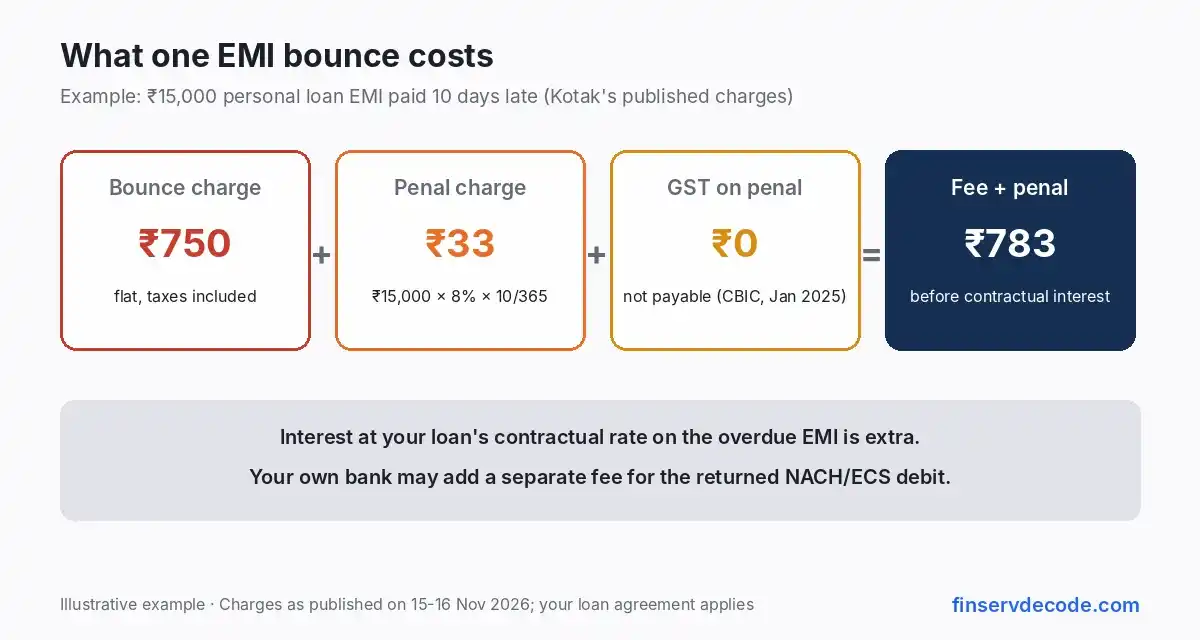
Bounce fee and penal charge only; contractual interest and any fee from your own bank add to this. Illustrative graphic created by Finserv Decode.
Now suppose you pay the same EMI after 30 days instead. The penal charge rises to about ₹99, plus contractual interest for the month. By then, the overdue could also be reported to the credit bureaus, which costs you far more than the fee.
RBI Guidelines for EMI Bounce and Penal Charges
RBI doesn’t prescribe a one-rupee amount for an EMI bounce or return fee; lenders publish their own. But any penalty for not meeting the repayment terms must follow RBI’s circular on penal charges in loan accounts (18 August 2023). It applies to new loans from 1 January 2024, and existing loans had to move to it at the next review or renewal, or within six months.
Here’s what the RBI guidelines for EMI bounce charges and penal charges say:
- Penal charges, not penal interest. A penalty for missing a payment must be a separate charge. It can’t be added to your loan’s interest rate.
- No interest on penal charges. Lenders can’t capitalise penal charges, so they don’t compound. Normal interest on the unpaid EMI can still run until you pay.
- Reasonable and disclosed. Each lender needs a board-approved policy, and the amount and reason must appear in the loan agreement, the KFS, and on its website.
- Told when charged. Reminders for a missed payment must mention the applicable penalty charge, and each time it’s levied, you must be told the reason.
- Not for credit cards. The circular doesn’t apply to credit cards, which have their own rules.
Is There a Grace Period for EMI Payment?
No, not under RBI rules. Many websites get this wrong. RBI doesn’t give a 7-day or any other grace period before a missed EMI counts as overdue. RBI’s clarification on asset classification says accounts are flagged as overdue as part of the lender’s day-end process on the due date itself.
Some lenders do wait a few days before charging. HDFC Bank, for example, applies its delayed payment penalty only if the EMI is unpaid 7 calendar days after the due date. But that’s the lender’s policy on the charge. The EMI is still overdue from its due date.
GST on Penal Charges and Bounce Fees
The CBIC’s Circular No. 245/02/2025-GST (28 January 2025) clarifies that no GST is payable on penal charges levied by regulated lenders in line with RBI’s 18 August 2023 directions.
A bounce or payment-return fee is a separate charge. Most lenders show it “plus GST” or “plus taxes”, while a few, such as Kotak, quote it inclusive of taxes. If GST appears on a penal charge in your loan statement, ask the lender to explain it.
EMI Bounce and CIBIL Score: When Does It Hurt?
Not the bounce itself; the unpaid EMI does. TransUnion CIBIL’s own myths and facts page says a bounced cheque doesn’t affect your credit score, because your bank account details aren’t in your credit report. But a missed EMI or credit card payment will.
What matters is whether the EMI is still overdue when your lender sends data to the bureaus. Under the RBI’s credit information reporting directions, from 1 July 2026, lenders report as of the 9th, 16th, and 23rd of each month and the last day of the month. If your EMI is unpaid on one of those dates, the report can show it as overdue, with the number of days past due.
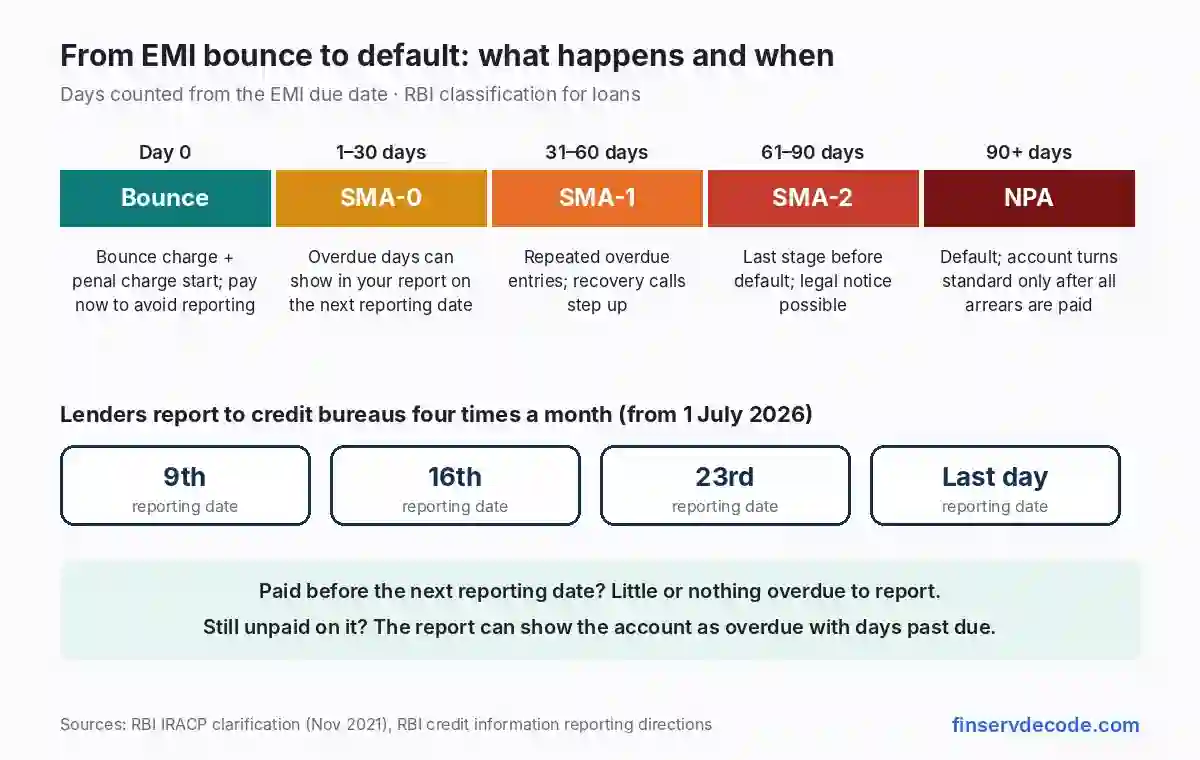
How an unpaid EMI moves from a bounce to SMA and NPA. Illustrative graphic created by Finserv Decode.
Does 1 EMI Bounce or a 1–2 Day Delay Affect Your CIBIL Score?
A short delay usually matters far less than a long one, but there’s no guaranteed safe window.
Suppose your EMI is due on the 5th and bounces. If you pay on the 7th and the lender posts it before the 9th, the next submission can show the account as current. If the EMI is still unpaid on the 9th, that submission can show it as a few days past due. The reporting dates aren’t a grace period; they only decide when your lender sends its next update.
With four reporting dates a month, even a delay of a few days can now reach your report. No one can tell you an exact number of points for one late EMI, because CIBIL doesn’t publish its scoring weights.
What Happens If 3 EMIs Bounce?
If the EMIs bounce and stay unpaid, the account moves through RBI’s stages, based on how long the oldest amount has been overdue:
| Days overdue | RBI classification | What it means for you |
|---|---|---|
| 1 to 30 days | SMA-0 | Penal charges, reminders; overdue days can appear in your report |
| 31 to 60 days | SMA-1 | Lender may step up follow-ups; repeated overdue entries |
| 61 to 90 days | SMA-2 | Last SMA stage before NPA |
| More than 90 days | NPA (default) | Recovery action, possible loan recall, serious damage to your credit report |
Days past due are counted from the original due date of the oldest unpaid EMI, not from when the lender called you.
With three consecutive monthly EMIs unpaid, the oldest one is roughly 60 days overdue, depending on the calendar. So the account is in or near SMA-2. It becomes an NPA only when the overdue amount stays unpaid for more than 90 days.
RBI’s clarification also says an NPA account becomes “standard” again only when the entire arrears of interest and principal are paid. Clearing just one EMI isn’t enough.
If you can’t pay, talk to the lender before the account reaches 90 days. And if you’re offered a settlement, understand the settlement process before you agree, because a settled status stays on your report for a long time.
Home Loan EMI Bounce: Same Rules Apply
RBI says these SMA stages apply to all loans, including retail and home loans. So a home loan EMI default shows in your CIBIL report the same way as a personal loan default. Once a home loan becomes an NPA, the lender’s recovery options against the property depend on the loan terms and the law.
Home loan EMI bounce charges can differ from personal loan charges, even at the same lender, so check the KFS or charges page for your exact home loan.
What DPD and Amount Overdue Mean in Your CIBIL Report
Each loan in your CIBIL report shows the current balance, the amount overdue (if any), and a month-by-month payment record for up to 36 months, according to CIBIL’s guide to reading your report.
- Amount overdue is the unpaid amount on that account as of the date the lender last reported. If it still shows a figure after you’ve paid, the report is waiting for the lender’s next update.
- DPD (days past due) in the payment history shows the actual number of days a payment was late in that month, such as 000 (on time), 012, or 045, not just 30, 60, or 90.
- Asset classification codes may appear in some months instead of days: STD (standard), SMA, SUB (sub-standard), DBT (doubtful), or LSS (loss). Anything other than 000 or STD tells a lender to look closer.
A lender reviewing your next loan application reads this grid, not just your score. A recent DPD on a home or personal loan often matters more to them than an old one followed by clean months.
How to Clear DPD in Your CIBIL Report
An accurate DPD can’t be deleted on request. It stays in the 36-month payment history and becomes less important as clean months build up after it. What you can do depends on whether the entry is correct:
| Situation | What to do | What changes |
|---|---|---|
| The DPD is correct, and the EMI is still unpaid | Pay all overdue instalments and confirm the payment is posted to your loan account | Days past due stop increasing once the overdue is cleared; the lender’s next submission reports the update |
| The DPD is correct and already paid | Keep every later EMI on time | The entry stays, but recent clean months outweigh it over time |
| You paid on time, but a DPD shows | Raise a dispute with the bureau and attach proof of payment | The lender must confirm; the dispute should be resolved within 30 days |
| The account isn’t yours or is a duplicate | Raise a dispute and inform the lender | Wrong entries are removed after the lender confirms |
If a complaint about incorrect credit information isn’t resolved within 30 days, compensation of ₹100 per day of delay is payable under CIBIL’s compensation framework. It’s shared between the lender and the bureau, based on who caused the delay.
Avoid agencies that promise to “remove DPD” for a fee. They can only file the same dispute that you can file for free. If several DPD entries have pulled your score down, this step-by-step plan to increase your CIBIL score shows what to fix first.
Is EMI Bounce a Criminal Offence?
A failed EMI debit doesn’t automatically make you a criminal. A bounce that you clear quickly is settled with charges.
But section 25 of the Payment and Settlement Systems Act, 2007 treats a dishonoured electronic transfer (such as a NACH debit) due to insufficient funds much like a bounced cheque under section 138 of the Negotiable Instruments Act. This applies when all of these conditions are met:
- The debit was for a legally enforceable debt or liability, such as your EMI
- It was initiated under the payment system’s procedural rules
- The lender sends you a written demand notice within 30 days of learning about the dishonour
- You don’t pay within 15 days of receiving that notice.
If all of these apply, the law allows imprisonment of up to two years, a fine of up to twice the amount, or both.
So if you receive a notice, don’t ignore it. Check the amount, then pay or agree on a plan in writing within 15 days. Keep your records, and take legal advice if you dispute the claim.
What to Do After Your EMI Bounces
1. Find out why it bounced. Check your bank statement and the lender’s SMS. A low balance, an expired mandate, and a technical error each need a different fix.
2. Pay the overdue EMI as soon as you can through the lender’s app, website, or payment link. Paying before the next reporting date (9th, 16th, 23rd, or month-end) gives the lender a chance to report the account as current. Ask for an itemised breakdown of the bounce fee, penal charge, and interest, and question any charge you think is wrong.
3. Keep the payment receipt with the transaction reference (UTR), date and time, along with the updated loan statement, until your credit report shows the account as current.
4. Fix the mandate if it was the cause. Ask the lender for a new NACH registration, or a repayment-date change if your salary arrives after the EMI date.
5. Check your credit report after the lender’s next reporting cycle, allowing a few days for the bureau to process it. If it still shows an overdue amount or delay you don’t agree with, dispute it with your receipt.
How to Remove or Get EMI Bounce Charges Waived
There are two different situations here.
If a charge is wrong, such as a duplicate debit, a wrong amount, or a fee applied for a bank-side technical failure, ask for a reversal. You’re entitled to a correction.
If the charge is valid under your agreement, a waiver is at the lender’s discretion. Your chances are better when:
- The bounce was caused by a technical error at either bank, and you have the bank’s confirmation.
- It’s your first bounce on a loan with a clean record.
- You’ve already paid the EMI and ask politely through the lender’s official complaint channel.
Complain in writing to the lender first, and keep the complaint number. If the lender rejects your complaint, replies unsatisfactorily, or doesn’t respond within 30 days, you can approach the RBI Integrated Ombudsman through RBI’s complaint portal, provided the lender and the complaint are covered by the scheme.
How to Avoid EMI Bounces
- Keep a buffer. If your budget allows, keep part or all of one EMI extra in the debit account. Treating EMIs as a fixed need, as in the 50/30/20 rule, keeps that money from being spent.
- Match the EMI date to your salary date. An EMI due on the 2nd with salary on the 7th will bounce whenever salary is late. Ask the lender to move the date, but check the fee first; Kotak, for example, charges ₹500 plus taxes to change the EMI date or repayment mode.
- Recheck the mandate after any bank change. A new salary account or a closed account breaks the old mandate silently.
- Set a reminder two days before the debit date to check your balance, especially in months with large expenses.
- Build an emergency fund. A few months of expenses saved, as explained in this guide on how to save money from salary, covers your EMIs if income stops.
If you need a new loan soon after a bounce, apply to one lender at a time. Several applications close together add enquiries, and this hard inquiry affects your CIBIL score.
EMI Bounce Charges FAQs
Does an ECS bounce affect my CIBIL score?
Not by itself. An ECS or NACH bounce is a failed debit, and bank account details aren’t part of your credit report. It affects your score only if the EMI stays unpaid on the lender’s next reporting date.
Will the lender try the auto-debit again after a bounce?
It depends on the lender, and a second failed attempt can mean a second charge. Paying the EMI manually as soon as you know about the bounce avoids that risk.
Can the lender charge twice if the EMI bounces twice?
Yes, if it’s scheduled charges per failed presentation and it presents the mandate again. Ask for the dates and return reasons of each attempt. If the same failed debit has been charged twice, ask for a reversal.
How long does a late EMI stay on my CIBIL report?
The payment history in your CIBIL report shows up to 36 months for each account, so a late month stays visible in that grid for about three years. Its effect on lending decisions fades as clean months are added.
Can I get a new loan after an EMI bounce?
Yes, if it was a one-off that you cleared quickly. Repeated or long overdues make approval harder; see how a personal loan with a low CIBIL score works and what lenders look at.
Can I pay a bounced EMI online?
Usually yes. Most lenders let you pay an overdue EMI through their app, website, or a payment link sent by SMS. Keep the receipt with the transaction reference until the payment shows in your loan statement.
Conclusion
EMI bounce charges are a fee of roughly ₹450 to ₹1,200 in the published personal loan schedules we checked. On top of that, there’s a separate penal charge on the overdue EMI, and sometimes a fee from your own bank. Still, that cost is small next to what a long overdue EMI does to your credit report.
If an EMI bounces, find out why, pay the overdue amount as soon as you can, ask for an itemised breakdown, fix the mandate, and keep the receipt. Then check your report after the lender’s next reporting cycle and dispute anything wrong. The faster you clear it, the less chance it shows up as days past due.
Disclaimer
This article is for general information only. It isn’t financial or legal advice. We took charges from each lender’s official website or Key Fact Statement on 17 November 2026, and they can change; the charges in your own loan agreement apply. Credit scoring models aren’t published in full, so the effect of a bounce or delay on any score varies. Finserv Decode has no commercial relationship with any lender mentioned.