If you want to know how to increase CIBIL score, start with your credit report, not with shortcuts. Your score goes up when you fix whatever pulled it down, and then keep a clean record month after month.
For most people, the fix comes from a short list: pay card balances down and keep usage low, dispute errors, clear overdue EMIs, close a settled account properly, stop applying for new credit, and keep old accounts open. Some of these can lift your score after your lender’s next update. Late payments and settlements take many months of clean history.
This guide shows you how to read your report, the seven steps to improve your CIBIL score, and how fast lenders now send updates to credit bureaus under the new RBI rules. We use a score of 600 as the main example because that’s where many people get stuck, and we also cover what changes if you start from 500, 650, 700, or 750. No one can promise an exact number of points by a date, and this guide doesn’t either.
What Is a Good CIBIL Score, and Is 600 Good?
The CIBIL score runs from 300 to 900, and TransUnion CIBIL says a score above 700 is generally considered good. So is 600 a good CIBIL score? No. A 600 is below the range most lenders prefer, but it’s a score you can fix.
A 600 tells a lender that something in your recent history needs a closer look. So your application is more likely to go to manual review, get a smaller amount or a higher rate, or be declined.
What Each CIBIL Score Range Means
Lenders set their own cut-offs, so there’s no official band for each score. The table below is a broad editorial guide, not a CIBIL or RBI rating system:
| Score range | General reading (not official) | What you may face |
|---|---|---|
| Below 600 | High risk; recent defaults or serious delays likely | Mostly secured credit or no approval |
| 600–649 | Below preferred range | Fewer lenders, higher rates, smaller amounts |
| 650–699 | Borderline | Approval depends heavily on income and existing EMIs |
| 700–749 | Within the range, CIBIL calls are generally good | Most lenders will consider you; pricing may vary |
| 750 and above | Strong | Wider choice, though approval and rates are not guaranteed |
What a 600 CIBIL Score Costs You
The rate gap is where a low score costs the most. Take a ₹5 lakh personal loan repaid in 36 monthly EMIs on a reducing balance:
- At 11% a year, total interest is about ₹89,300.
- At 20% a year, total interest is about ₹1,68,900.
That’s a difference of roughly ₹79,600, before fees. These rates are only examples. Your actual rate depends on the lender, your income, and your existing debt as well, not on the score alone.
If you need a loan before your score recovers, see how a personal loan with a low CIBIL score works and what lenders check besides the score.
Why Is Your CIBIL Score Low? Check Your Report First
Two people with the same low score can need completely different fixes. So before you cut spending or close cards, download your full credit report and read it section by section.
How to Get Your Free Credit Report
Under the RBI’s Credit Information Companies Directions, you can get one free full credit report, including the credit score, from each credit bureau once every calendar year (January to December).
There are four RBI-registered bureaus: TransUnion CIBIL, Experian, Equifax, and CRIF High Mark. Your free CIBIL report shows your CIBIL score. The other bureaus’ reports help you spot an account that one lender reported differently.
Four Parts of the Report to Check
- Account information. This lists each loan and card with a month-by-month payment record. Look for any month showing days past due (DPD). “000” or “STD” means paid on time. If a code is unfamiliar, check the report’s glossary before you assume it’s a late payment.
- Account status. Look for “Settled”, “Written-off”, “Post (WO) Settled” or “Suit Filed”. These are the heaviest negative marks.
- Current balance against limit. Add up the balances and limits on all your credit cards to see your overall credit utilisation.
- Enquiries. These are loan or card applications that lenders checked on your behalf. Several in a few months signal heavy credit seeking. Your own score checks don’t count as lender enquiries.
Match What You Find to the Right Fix
Once you know what’s in the report, match it to the fix and the realistic time it needs:
| What the report shows | Main cause of a low score | First fix | What to expect |
|---|---|---|---|
| Card balances above 50% of limits | High utilisation | Pay balances down and keep them low | Lower balance shows after the lender’s next update |
| A loan you never took out or a closed loan still open | Report error | Raise a dispute with the bureau | Correction within the 30-day dispute window if the lender confirms it |
| DPD in the last 6–12 months | Recent late payments | Clear overdues; no new delays | Needs a longer run of on-time payments |
| Settled or written-off account | Past default | Ask the lender about closing it in full and get the status updated | History stays visible even after an update |
| Many enquiries, few accounts | Credit seeking | Avoid unnecessary applications | Older enquiries matter less over time |
| One or two accounts, under a year old | Thin file | Use existing credit lightly and pay in full | Builds only with time |
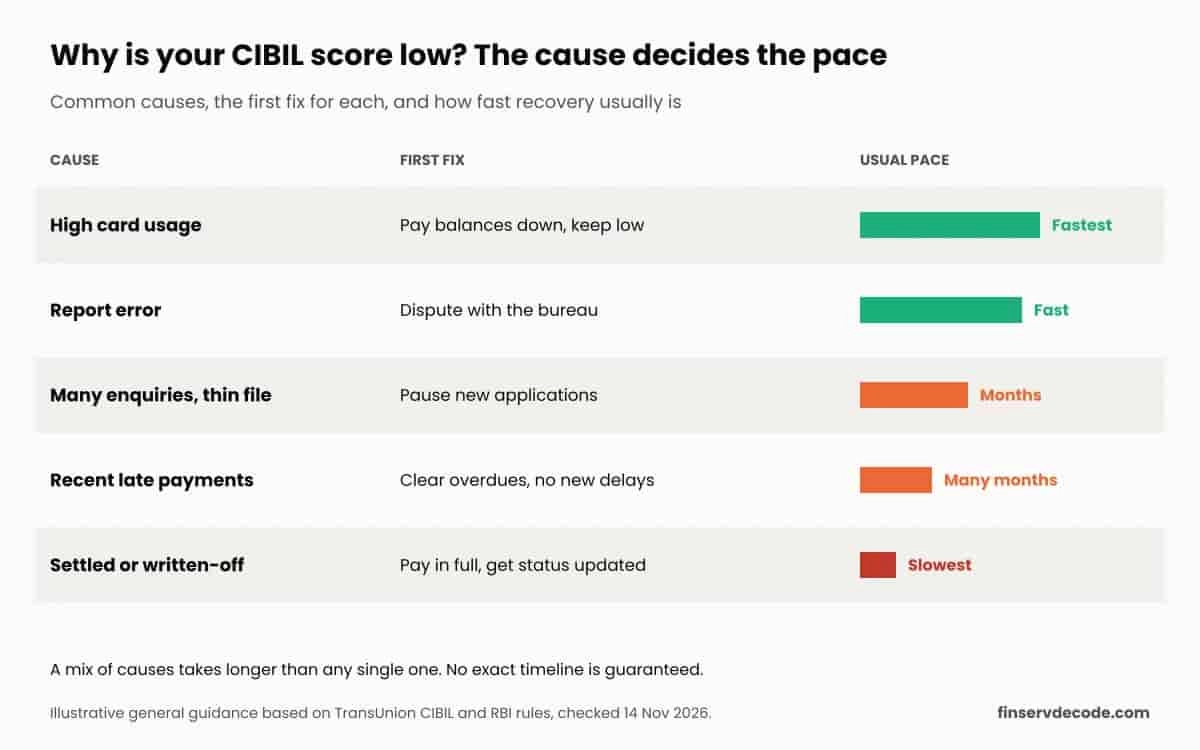
The cause of a low score decides how fast it can recover. Illustrative graphic created by Finserv Decode.
How to Increase CIBIL Score: 7 Steps
Work through these steps in order. The first two can move your score fastest. The rest build the clean history that takes a low score, such as 600, the full distance to 750 and beyond.
1. Dispute Every Error in Your Credit Report
Errors are common enough that it’s worth checking your report line by line. Look for a loan in your name that you never took, a closed loan still showing an outstanding balance, a paid EMI marked late, or a duplicate account. Raise a dispute on the bureau’s website for each wrong entry. The bureau then checks it with the lender that reported it.
RBI rules give the lender 21 days and the bureau 9 days, so a dispute should be resolved within 30 calendar days. If it takes longer, you’re entitled to compensation of ₹100 for each calendar day of delay, whatever the outcome of the dispute. The lender or bureau responsible for the delay pays its share to the bank account you give when filing. CIBIL’s compensation framework explains how the amount is calculated and shared between the lender and the bureau.
If you closed a loan and hold the no-objection certificate (NOC), but the report still shows the loan as active, ask the lender to confirm that it has sent the updated status to the bureau. Then raise a dispute with the NOC as proof. The bureau changes lender-reported data only after the lender confirms it.
2. Reduce Credit Card Usage and Keep Balances Low
Credit utilisation is the share of your total card limit that you’re using. With a combined limit of ₹1 lakh and a ₹65,000 balance, your utilisation is 65%. CIBIL doesn’t publish a cut-off, but keeping it under about 30% (₹30,000 here) is a common guideline, and lower is better.
Card issuers report the balance as it stands on their reporting dates, which need not match your statement date. So paying the bill on the due date isn’t enough if the card runs close to its limit for most of the month.
Here’s what helps:
- Keep the balance low through the whole billing cycle.
- Make a part-payment mid-cycle after large purchases.
- Pay the total amount due by the due date, not just the credit card minimum due, which leaves the rest of the balance to attract interest and keeps utilisation high.
- Spread spending so that no single card sits near its limit, even if your overall usage looks fine.
A higher credit limit also lowers utilisation, as long as your spending stays the same. Before you ask for one, check with the card issuer whether it involves a fresh credit check that adds an enquiry.
3. Clear Overdue Amounts and Pay Every Due in Full
If any EMI or card bill is overdue right now, clear it first. An overdue account keeps adding late months to your record, and each new late month undoes progress you’ve made elsewhere. This explainer on the impact of missed EMIs on your CIBIL score shows how days past due are recorded and why recent delays weigh more.
Set up auto-debit for every EMI and for the total amount due on each card. That way, a busy week or a forgotten date can’t add a new late mark.
If you miss payments because your account runs short before the due date, fix the budget, not just the reminder. A simple framework such as the 50/30/20 rule helps you set aside EMI money as a fixed need on salary day.
4. Repair a Settled or Written-Off Account
A settled status means the lender accepted less than the full amount owed under an agreed settlement. Written-off means the lender has recorded the unpaid amount as a loss in its books. It doesn’t cancel your obligation to repay. Both stay visible to future lenders for a long time, so a score held at 600 by either moves slowly.
Here’s how to improve your CIBIL score after settlement:
- Ask for the full closure amount. Ask the lender for the total needed to close the account, including the part waived in the settlement.
- Get it in writing first. Before paying, get written confirmation that paying this amount will lead the lender to report the account as closed with nothing due.
- Pay and collect proof. Keep the receipt, and get a closure letter or NOC that states the account is closed.
- Ask for the bureau update. Ask the lender to report the status as closed to the bureaus, and check your report after the next reporting cycle.
- Dispute if nothing changes. If the status hasn’t changed after a month, raise a dispute and attach the closure letter.
In CIBIL’s own example, a borrower paid the remaining amount, got the NOC, and raised a dispute, and the status changed from settled to closed within 30 days.
A status update doesn’t erase the history of the default; the past late months remain. But it does change how a new lender reads the account. The full difference between the two outcomes is covered in this comparison of loan settlement vs. loan closure.
5. Pause New Loan and Card Applications
Each application usually triggers a hard enquiry. When your score is low, it’s tempting to apply to several lenders and apps, hoping one says yes. But every application adds an enquiry, approved or not, and a cluster of them makes the next lender more cautious.
Hold off on new applications while the steps above take effect. Apply again once your report is clean and you meet the lender’s criteria.
Checking your own score is a soft enquiry, and it doesn’t affect your score. Here’s how a hard inquiry affects your CIBIL score, and how long it matters.
6. Keep Old Cards Open and Check Shared Liabilities
An old card with a clean record adds length to your credit history and limit to your utilisation calculation. Unless it charges an annual fee you can’t justify, keep it open. Some issuers close cards that stay unused for long, so put an occasional small expense on it that you’d make anyway, and pay it in full.
Also check accounts where you aren’t the main borrower. According to TransUnion CIBIL, a loan where you’re a guarantor appears in your report, and a default by the main borrower affects your score too. A default on an add-on card also reflects on both the primary and the add-on cardholder.
If someone else’s missed payments are pulling you down, talk to them and the lender about clearing the dues. And avoid standing guarantee for new loans until your score recovers.
7. Build History if Your File Is Thin, Without New Debt
A thin file is different from a damaged one. It means your report shows only one or two young accounts, so the score has little data to work with. Use what you have lightly and pay in full.
If you have no card and need one, a card issued against a fixed deposit (a secured card) is usually easier to get. Check its fees and terms before applying, because it’s still credit and is reported like a regular card.
Don’t take a personal loan or consumer loan just to improve your credit mix. A new loan adds an enquiry, an EMI, and the risk of another missed payment, which is the last thing a low score needs.
How Fast Can You Increase Your CIBIL Score?
Your score changes only when the bureau receives new data from your lenders, so the reporting schedule sets the pace.
Under the RBI’s Credit Information Reporting Directions, from 1 July 2026, banks and NBFCs report credit information as of the 9th, 16th and 23rd of each month and the last day of the month. Updates for the 9th, 16th and 23rd go to the bureaus within four calendar days. The full month-end file goes by the 5th of the next month.
Earlier, lenders reported twice a month, so a payment could take several weeks to appear. With four reference dates, a cleared card balance or a closed loan can reach the bureau faster.
But the four days is the lender’s deadline to send data, not a promise that your score will refresh in four days. The exact timing depends on your lender, when your payment falls in the cycle, and the bureau’s processing.
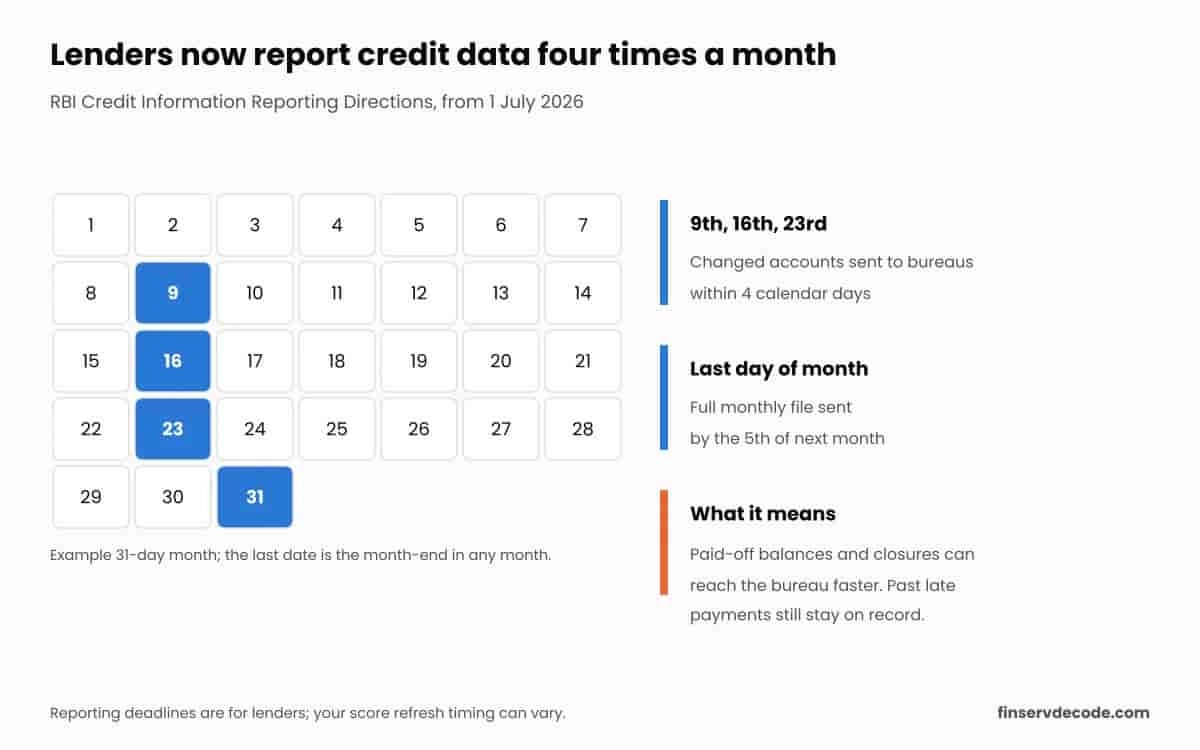
From 1 July 2026, lenders report credit data four times a month. Illustrative graphic created by Finserv Decode.
Faster reporting doesn’t erase past late payments or shorten the time clean history needs. A year of on-time payments still takes a year.
How to Increase CIBIL Score Fast: Is 30 Days Possible?
If you’re searching for how to increase CIBIL score fast, be realistic: a jump from 600 to 750 in a month is unlikely. Here’s what can realistically show within 30 days:
- A lower card balance, after your lender’s next reporting date.
- A corrected entry, after a successful dispute.
If either was the main cause of your low score, the improvement can be noticeable. If the cause is late payments or a settlement, a month brings little change. There’s no legitimate way to raise a score immediately or in one day, whatever an agency or app promises.
How Long Does It Take to Improve Your CIBIL Score?
There’s no fixed timeline, and CIBIL doesn’t publish one, whether you’re going from 600 to 750 or from 700 to 750. The pace depends on what caused your low score, how recent the negative entries are, how many accounts are affected, and how consistently you repay from now on.
Here’s what usually moves first, and what takes longer:
| Main reason for a low score | What can improve first? | What takes longer | Time Line |
|---|---|---|---|
| High card utilisation only | Lower balances after the lender’s next update | Keeping balances low every month | Fastest |
| Report error | The wrong entry corrected after the dispute | Nothing, if the error was the only problem | Fast, once resolved |
| Several enquiries, thin file | No new enquiries added | Building enough repayment history | Months |
| Recent late payments | Overdue status cleared | A long run of on-time payments | Many months |
| Settlement or write-off | Status updated if the lender agrees after full payment | Lenders’ trust in an account with a default history | Slowest; often a year or more |
This is general guidance, not a promise. Two people with the same score can need very different times, and a mix of causes takes longer than any single one.
How Much Does a CIBIL Score Increase per Month?
There’s no fixed monthly increase. A score can rise sharply in one month when a large card balance is cleared, then move only a few points a month while clean payment history builds. If you check monthly, compare the trend over three to six months instead of reacting to a single month.
How to Increase CIBIL Score From 500, 650 or 700 to 750
The steps don’t change with your starting score, but the order and the time do. The lower you start, the more the fix depends on clearing old dues rather than lowering card balances.
| Starting score | What to check in the report | Where to focus | Outlook |
|---|---|---|---|
| Below 500 | Defaults, suits filed, written-off or settled accounts | Deal with the most serious overdue accounts first; correct any wrong entries | Long recovery |
| 500–599 | Recent missed payments, a settlement, high card balances | Clear current overdues, address the settled account, no new applications | Slow but steady with clean repayment |
| 650–699 | High card usage, a few late months, recent enquiries | Utilisation below about 30% and zero new delays | 750 often within reach once the weak area is fixed |
| 700–749 | Remaining high balances, recent enquiries, errors | Protect the clean record; avoid new enquiries | Small changes can make the difference |
From 500 to 750: expect the longest climb, because serious defaults need both closure and a long clean record.
From 650 or 700 to 750: the gap is usually one weak area, such as high card usage or a recent enquiry cluster. Fixing that one area often closes most of the gap.
How to Improve CIBIL Score Without a Credit Card
You don’t need a credit card to improve an existing score. Without one, your score depends on your loan accounts, so focus on these:
- Pay every EMI on time. This applies to a home, vehicle, education, gold, or personal loan. Each month of on-time payment adds to your record.
- Correct errors through a dispute. This needs no new credit.
- Avoid applying to several loan apps. They create enquiries and, if you borrow, more EMIs to manage.
- Check whether you have a score at all. If you have no active credit, you may not have a score yet. If you need credit anyway, a secured card against a fixed deposit is one option to compare. Don’t take on debt only to create a score.
Without a credit card, the fastest lever (lowering card utilisation) isn’t available. So your improvement depends on time and clean repayment.
How to Increase CIBIL Score From 750 to 800
Getting from 750 to 800 needs the same habits, kept for longer: utilisation well below 30%, no late payments, few enquiries, and older accounts left open. The score rises slowly at this level, because there’s little negative data left to fade.
900 is the top of the scale, but a higher score doesn’t guarantee approval or a particular rate. Once you’re comfortably above a lender’s cut-off, your income, existing EMIs, employment, and the lender’s own policy carry more weight. Protect the score you have by keeping auto-debits active and checking your report at least once a year.
Mistakes That Slow Your CIBIL Score Recovery
- Paying an agency that promises to “clean” your report. Accurate negative information can’t be removed on request, and no one can guarantee a score jump. You can dispute errors directly with the bureau, free of charge.
- Choosing a settlement only because it costs less. A settlement ends the immediate pressure but leaves a long-lasting negative status. If you’re struggling, ask the lender about all repayment options and how each will be reported to the bureaus, and get the terms in writing before you agree.
- Closing your oldest card to “clean up” your report. It cuts your total limit and your credit history.
- Applying to many lenders or loan apps at once after a rejection.
- Checking only the score, not the report. The score tells you that something is wrong; the report tells you what.
How to Increase CIBIL Score FAQs
What is the fastest way to increase CIBIL score?
Lowering high card balances and getting report errors corrected are usually the fastest, because both can show after your lender’s next update. Late payments and settlements need many months of on-time repayment, so there’s no shortcut for those.
What is the 7-year rule in CIBIL?
The Credit Information Companies Regulations, 2006 require bureaus and lenders to keep credit information for at least seven years. That’s a minimum retention period, not a rule that a default disappears after seven years. Scoring models give more weight to recent behaviour, so an old default hurts less over time while you keep a clean record.
Does my salary or bank balance affect my CIBIL score?
Not directly. The score is calculated from the accounts and enquiries in your credit report, which doesn’t contain your savings, investments, or fixed deposits. Lenders check income separately when you apply, so a higher salary can improve your approval chances without changing the score.
Do lenders check only my CIBIL score?
Not always. Lenders may use one or more of the four bureaus, and your scores can differ because each bureau uses its own model and data can reach them at different times. Check your free report from each bureau once a year to catch errors that show up in only one.
Why did my score fall after I closed a loan?
Closing a loan can reduce your active accounts or change your credit mix, so a small dip after the final payment can happen. It doesn’t mean you did anything wrong. Here’s why your credit score drops after paying off a loan, and what to check.
Can I get a loan after a settlement?
It’s harder, especially for unsecured loans, because lenders see the settled status. Paying the waived amount, getting the status updated, and then keeping a year or more of clean repayment improves your chances. Meanwhile, a secured loan against gold or a fixed deposit may be easier to get.
How often should I check my CIBIL score while improving it?
Once a month is enough. Checking your own score doesn’t lower it, but daily checks won’t show anything new, because the score changes only when lenders report fresh data. Look at the account details too, to see whether a payment or correction has reached the report.
Conclusion
To increase your CIBIL score, read your full report first and fix the main cause: lower your card balances, dispute errors, clear overdues, and repair any settled account. Then keep every payment on time and stop applying for new credit while your record rebuilds.
With lenders now reporting four times a month, good changes reach the bureau sooner than before. But how long the climb takes, whether from 600 to 750 or 750 to 800, still depends on what caused your low score, and only steady, on-time repayment gets you there.
Disclaimer
This article is for general information and education only. It isn’t financial or credit advice. Credit bureaus don’t publish their scoring models in full, so score changes and timelines differ from person to person. We took regulatory details from Reserve Bank of India directions and TransUnion CIBIL pages; all details are checked as of now. Lender cut-offs and interest rates vary, and examples are illustrative. Finserv Decode has no commercial relationship with any lender or credit bureau mentioned in this article.