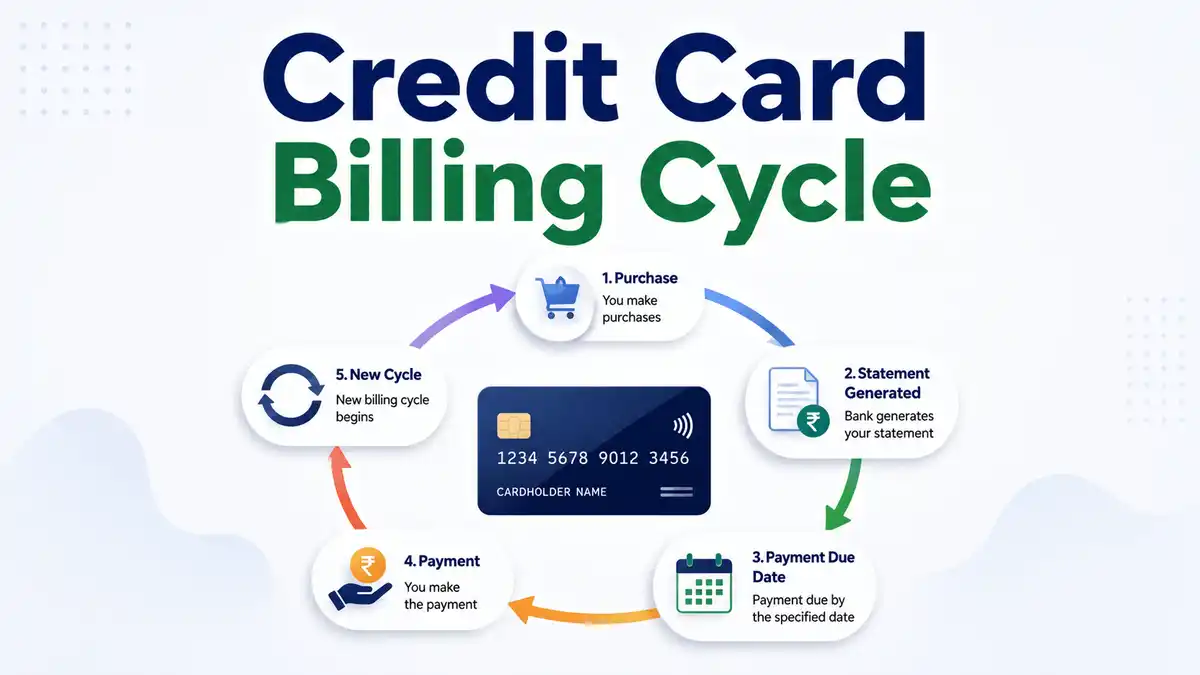
A credit card billing cycle is the period, usually about a month, in which your bank records everything you spend on the card. At the end of it, the bank adds up those purchases and sends you one bill, called a statement. You then get a few weeks to pay.
Three dates run the whole thing: the day you buy, the day the bill is made, and the day the payment is due. This article explains each one with an example, shows which billing date suits you best, and tells you how to change yours.
What Is a Credit Card Billing Cycle?
If you’re asking what a credit card billing cycle is, here is the simplest way to see it. Say your bill is made on the 5th of every month. Your billing cycle then runs from the 6th of one month to the 5th of the next.
- Anything you buy from the 6th to the 5th goes into the bill made on the 5th.
- Anything you buy on the 6th or later goes into the next bill.
RBI defines a billing cycle as the regular length of time between the closing dates of two bills in a row. Banks also call it the billing period or statement cycle.
The Three Dates You Need to Track
Most confusion about the credit card billing cycle and due date comes from mixing up these three dates:
| Date | What It Is | Example |
|---|---|---|
| Transaction date | The day you use the card | You buy shoes on 6 March |
| Statement date | The day the cycle closes, and your bill is made | Your bill is made on 5 April |
| Payment due date | The last day to pay without a late fee | You must pay by 22 April |
The credit card statement date is also called the billing date or the credit card bill generation date. All three names mean the same day.
Billing date vs statement date vs due date
People often search for billing date vs statement date vs due date as if they were three different things. In practice, there are only two:
- Billing date and statement date are the same day. The bank closes your cycle and makes your bill on that date.
- The due date is a later date, usually two to three weeks after the statement date.
RBI’s card rules say banks must send statements without delay and give customers at least a fortnight to pay before interest is charged. Most banks give a little more than that.
Credit Card Billing Cycle Example, Step by Step
Here’s how a credit card billing cycle works with real dates. The cycle runs from 6 January to 5 February. The statement date is 5 February, and the due date is 22 February.
| Date | Purchase | Amount | In the 5 February Bill? |
|---|---|---|---|
| 9 January | Groceries | ₹2,200 | Yes |
| 15 January | Fuel | ₹3,000 | Yes |
| 28 January | EMI instalment | ₹4,500 | Yes |
| 2 February | Dining | ₹1,800 | Yes |
| 6 February | Mobile recharge | ₹500 | No, it goes into the 5 March bill |
The bill made on 5 February shows a total amount due of ₹11,500.
- Pay ₹11,500 by 22 February: you pay no interest.
- Pay less than ₹11,500: interest is charged on the unpaid part, counted from the date of each purchase.
- Pay nothing: a late fee is added too.
How Long Is a Billing Cycle?
If you’re wondering how long a billing cycle is, it’s usually 28 to 31 days. It follows the calendar, so the length changes a little from month to month. A cycle that closes on the 5th is 28 days long in a 28-day February and 31 days long after a 31-day month.
You don’t need to count the days. Your statement date stays the same every month, and that’s the only date you need to remember.
How Your Billing Cycle Decides Your Interest-Free Days
Your billing cycle also decides how long you get to pay for each purchase without interest. A purchase made just after the statement date gets the most time. One made just before it gets the least.
Using the same card (statement on the 5th, due on the 22nd):
| Purchase Date | Billed On | Due Date | Interest-Free Days |
|---|---|---|---|
| 6 January | 5 February | 22 February | About 47 days |
| 20 January | 5 February | 22 February | About 33 days |
| 4 February | 5 February | 22 February | About 18 days |
So for a large, planned purchase, buying a day or two after your statement date gives you the longest time to pay. This only works if you pay the full bill. If any balance is carried forward, new purchases collect interest from day one. There’s a full example of how that interest is counted with daily numbers.
What Is the Best Billing Cycle for a Credit Card?
There’s no single best billing cycle for credit card users. The best one is the cycle that puts your due date a few days after your income arrives. That way, the money is in your account when the bill is due.
Here’s a rough guide, assuming your due date falls about 18 days after your statement date. Check the actual gap on your own statement.
| When You're Paid | A Due Date That Works | Statement Date That Gives It |
|---|---|---|
| 1st of the month | 4th to 7th | Around the 17th to 20th |
| 7th of the month | 10th to 13th | Around the 23rd to 26th |
| Last day of the month | 3rd to 6th | Around the 16th to 19th |
| Irregular income | Soon after your most reliable payment | Count back about 18 days |
Two more tips:
- If you have more than one card, keep their due dates close together, or line them all up after your salary date. It’s easier to track.
- Don’t choose a date only to stretch interest-free days. A due date you can always meet matters more.
Banks assign a billing cycle when they issue the card. If yours doesn’t suit you, you can change it.
Can You Change Your Credit Card Billing Cycle?
Yes. This is an RBI rule, not a favour from the bank. RBI’s FAQ on credit and debit cards says cardholders must get the option to change their billing cycle at least once. Banks can offer this through their helpline, email, IVR, internet banking, and mobile app.
Before you ask for a change:
- You’re guaranteed one change. More changes depend on your bank’s own policy.
- Clear your current dues first if you can. Some banks ask for this.
- Expect one unusual cycle. The cycle in which the change happens can be shorter or longer than normal, so your next bill and due date may come at a different time. Ask the bank for the exact dates.
- Update your auto-pay and reminders to match the new due date.
How to Check or Change Your Billing Cycle, Bank by Bank
Menu names inside bank apps change often, so this table tells you where to look and not which button to press.
| Bank | Where to Check Your Cycle | Where to Ask for a Change |
|---|---|---|
| SBI Card | Statement, SBI Card app or website | App, website, or customer care |
| HDFC Bank | Statement, mobile app, or net banking | App, net banking, or customer care |
| ICICI Bank | Statement, iMobile app, or internet banking | iMobile, internet banking, or customer care |
| Axis Bank | Statement, mobile app, or internet banking | App, internet banking, or customer care |
| Kotak Mahindra Bank | Statement, mobile app, or net banking | App, net banking, or customer care |
| BOBCARD | Statement, BOBCARD app, or website | App or customer care |
| IDFC FIRST Bank | Statement, mobile app, or net banking | App, net banking, or customer care |
In the app, look under card services or card settings for an option like “change billing cycle” or “change statement date”. If you can’t find it, call customer care and ask for it. The RBI rule applies to every bank.
Billing Cycle, Minimum Due and the Interest-Free Period
Your billing cycle decides what goes into a bill. What happens next depends on how much you pay:
- Pay the total amount due: no interest on your purchases.
- Pay only the minimum amount due: no late fee, but interest is charged on the rest, and new purchases lose their interest-free days.
- Pay nothing: late fee plus interest.
The minimum due is worked out differently by each bank. The cost of relying on it is shown in the tables on what paying only the minimum leads to.
One RBI rule helps here. A bank can charge a late fee or report you as late only when your payment is more than 3 days past the due date, as set out in RBI’s card rules for banks. Interest can still apply for those days.
Billed vs Unbilled Credit Card Transactions
Your app often shows an “unbilled amount” next to your total amount due. Here’s the difference:
| Factor | Billed | Unbilled |
|---|---|---|
| What it is | Spends already on your latest bill | Spends made after your last statement date |
| When you pay | By the current due date | By the next due date |
| Counts against your limit? | Yes | Yes |
The ₹500 recharge on 6 February in the example above is an unbilled transaction. It reduces your available limit right away, but you don’t have to pay it until the next bill.
Your total outstanding is billed plus unbilled. That’s what you’d pay to bring the card to zero today.
Does Your Billing Cycle Affect Your Credit Score?
Not directly. Credit bureaus don’t score your billing cycle. They look at how much you owe and whether you pay on time.
Timing still matters in one way. Under RBI’s revised credit reporting rules, in force from 1 July 2026, lenders report your data four times a month: on the 9th, 16th, 23rd, and the last day. So the balance on your card on those dates is what the bureaus see, not only the balance on your statement date.
If you spend heavily in a month, paying part of the bill before the next reporting date can keep your reported usage lower. This and other habits are covered under using a card to build a CIBIL score.
What Happens If You Use 90% of Your Credit Limit in a Cycle?
There’s no penalty from the bank, and your card keeps working as long as some limit is left. The effect is on your credit profile.
CIBIL’s article on using a credit card for a better credit score says keeping your card spend to 30% of your limit is considered a healthy ratio. Using 90% is far above that.
One heavy month for a real expense isn’t a big problem. Staying near your limit month after month is what lenders notice. If you need to spend that much, pay part of it before the bill is made.
Does the 15/3 Rule Work for Indian Credit Cards?
The 15/3 rule is a tip from the US. It says to pay part of your bill 15 days before the due date and the rest 3 days before, so that a lower balance is reported to the bureaus.
It doesn’t fit India well. Here, lenders report on four fixed dates a month, not on your statement date. Two payments on a fixed 15/3 pattern don’t line up with those dates in any reliable way.
What works is simpler. Keep your balance low through the month, and pay the full bill by the due date.
Managing Billing Cycles When You Have More Than One Card
Each card has its own statement date and due date. That can be useful or confusing.
- Write down both dates for every card, or set reminders in your phone.
- Use the card whose statement date has just passed for a large purchase. It gives you the longest time to pay.
- Set auto-pay on every card, so a card you rarely use doesn’t get missed.
- Line up the due dates using the one-time change, if tracking them is hard.
These habits are part of using a credit card well day to day.
5 Billing Cycle Mistakes That Cost Money
- Making a big purchase just before the statement date. It’s billed almost at once, so you get the least time to pay, and it can raise your reported usage.
- Tracking the statement date but forgetting the due date. Missing the due date brings a late fee and interest.
- Treating the minimum due as the normal payment. Interest keeps building on the rest.
- Assuming all your cards have the same cycle. This is how payments on a second card get missed.
- Looking only at the total and not the full statement. Wrong charges and forgotten subscriptions go unnoticed.
FAQs About Credit Card Billing Cycles
What is a billing cycle on a credit card?
It’s the period, usually 28 to 31 days, in which the bank records your card spending before making one bill for you.
Is the billing date the same as the statement date?
Yes. Both mean the day your cycle closes and your bill is made. The due date is a separate, later date.
How many days do I get to pay after the bill is made?
RBI rules ask banks to give at least a fortnight. Most banks give about two to three weeks. Your statement shows the exact due date.
Can I change my credit card billing cycle?
Yes. RBI rules give you the option to change it at least once. You can ask through the bank’s app, net banking, IVR, email, or customer care.
Does a purchase made after the statement date go into the next bill?
Yes. It shows as unbilled until your next statement is made.
When is the best time to make a big purchase on a credit card?
A day or two after your statement date. It gives you the longest time before the payment is due. Spend only what you can repay in full.
How long is 2 billing cycles?
About two months, or roughly 56 to 62 days.
What if my due date falls on a holiday?
Pay before the holiday to be safe. Online payments work on holidays, but some methods take time to reach your card account.
Why is my first billing cycle shorter or longer than usual?
Your first cycle starts when the card is issued and ends on your fixed statement date, so it can be shorter or longer than a month.
Can I pay my credit card bill before the statement is made?
Yes. You can pay at any time. An early payment reduces your balance and frees up your limit, and the bill made later will be smaller.
Conclusion
Your credit card billing cycle is the bank’s monthly window for adding up your spending. Know your statement date and your due date, keep the due date just after your income arrives, and pay the full bill each time. If the dates don’t suit you, use your right to change them once.
Disclaimer: This article is for general information and education only. It is not financial advice. Finserv Decode is not a bank or card issuer.
Billing cycle lengths, due dates, and the steps to change a cycle differ by bank and card, and can change over time. RBI rules were checked as of now, and they may change at any time. The examples here are illustrations. Check your own statement, your bank’s app, and your card’s latest Most Important Terms and Conditions (MITC) for the terms that apply to you.