So, how does a credit card work? Your bank gives you a credit limit. When you buy something with the card, the bank pays the shop for you. All your purchases for the month are added to one bill, called a statement. If you pay the full bill by the due date, you pay no interest. If you pay less, interest is charged on what’s left.
That’s the short version. This article goes through it step by step: what happens in your account, what happens behind the scenes when you swipe, how the bill and due date work, and where interest starts. For the basics of card types and who can apply, see what a credit card is and who can get one.
How Does a Credit Card Work in Simple Terms?
If you want to know how a credit card works for beginners, think of it as a short loan that renews every month:
- You buy something with your card at a shop, on a website, or in an app.
- Your bank approves the payment and pays the shop. You’re using the bank’s money, not your account balance.
- The amount is added to what you owe, and your available limit goes down by the same amount.
- The bank records every purchase in the month the same way. This period is called your billing cycle.
- The bank sends you a statement at the end of the cycle, with the total you owe and a due date.
- You pay the bill. Your limit is restored by the amount you pay, and the next cycle begins.
Credit Card Terms You Need to Know First
| Term | What It Means |
|---|---|
| Credit limit | The most you can owe on the card at any time |
| Available credit | What's left to spend right now |
| Billing cycle | The roughly one-month period covered by one bill |
| Statement date | The day your bill is made |
| Payment due date | The last day to pay without a late fee |
| Total amount due | Your full bill. Pay this to avoid interest |
| Minimum amount due | The smallest payment that avoids a late fee |
| Interest-free period | The time between a purchase and the due date |
Credit Card vs Debit Card: The Main Difference
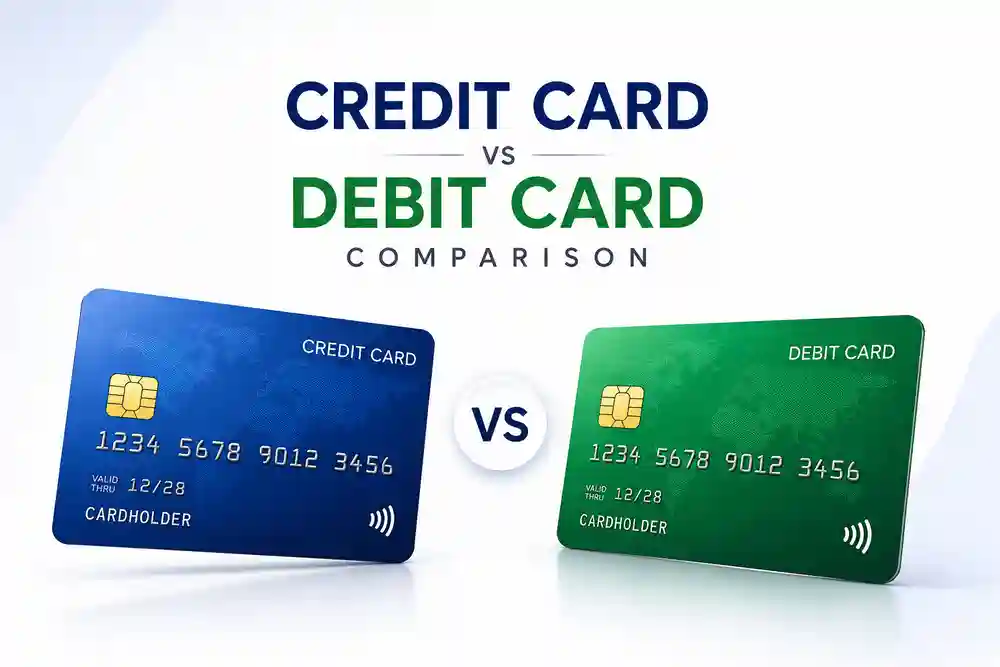
| Feature | Credit Card | Debit Card |
|---|---|---|
| Whose money do you spend | The bank's, up to your limit | Your own, from your bank account |
| When you pay | Later, when the bill comes | Right away |
| Interest | Only if you don't pay the full bill on time | None |
| Effect on credit score | Builds your credit history | No effect |
| If there's fraud | The disputed amount is the bank's money | Money leaves your account first |
What Happens When You Swipe a Credit Card
To understand what happens when you swipe a credit card, you need to know who’s involved. A card payment takes a second or two, but five parties take part in it:
| Who | Role |
|---|---|
| You | The cardholder who makes the purchase |
| The merchant | The shop or website you're paying |
| The acquiring bank | The merchant's bank, which accepts card payments for it |
| The card network | Visa, Mastercard, RuPay, American Express, or Diners Club. It connects the two banks |
| The issuing bank | Your bank, which gave you the card |
The credit card transaction process, step by step
This is how credit cards work behind the counter. The credit card transaction process has four stages:
- Authorisation. You tap, insert, or swipe your card. The shop’s machine sends the request to the acquiring bank, which passes it through the card network to your bank. Your bank checks that the card is active, that you have enough limit, and that the payment doesn’t look like fraud. It then approves or declines, usually within a second or two.
- Authentication. You prove it’s you. At a shop, that means entering your PIN. For tap-to-pay, payments below ₹5,000 go through without a PIN.
- Clearing and settlement. Approved payments are sent for settlement, often in a batch at the end of the day. The card network moves the money from your bank to the merchant’s bank.
- Payout. The merchant’s bank credits the merchant, usually within a day or two, after taking its fee.
You don’t see any of this. You only see “approved” on the machine and an SMS on your phone.
Who pays for the transaction?
For most purchases, you pay nothing extra. The merchant pays a small fee on each card payment, and that fee is shared by the acquiring bank, the card network, and your bank.
Banks earn from credit cards in three main ways: this merchant fee, the interest paid by people who don’t pay their bill, and charges like annual fees and late fees. If you pay in full every month, you mostly use the card at no cost.
What Do Pending, Posted, and Reversed Transactions Mean?
| Status | What It Means |
|---|---|
| Pending | The payment is approved, and your limit is reduced, but it isn't final yet |
| Posted | The payment is settled and shows as a confirmed charge |
| Reversed or refunded | The payment was cancelled or returned, and the amount comes back to your card |
A few things to know:
- A pending amount can change or disappear. If a payment fails after approval, the hold is released. This can take a few days.
- A refund comes back to your card, not your bank account. It reduces your bill. If you’ve already paid the bill, it shows as a credit balance and is adjusted against your next spends.
- You still pay by the due date while a refund is pending, unless the bank tells you otherwise.
What Happens When You Pay With a Credit Card Online
Online payments follow the same four stages, with a few differences:
- You enter your card number, expiry date, and CVV at checkout.
- A payment gateway sends these details securely to the banks.
- Your bank asks you to confirm the payment. In India, this is usually an OTP sent to your phone, though banks can use other approved methods too.
- Once you confirm, the payment is approved and settled like any other.
When you save a card on a website, the site doesn’t store your real card number. Under RBI rules, it stores a coded version called a token, which works only on that site. Your card details stay with the bank and the card network.
If you have a RuPay credit card, you can also link it to a UPI app and pay by scanning a QR code. The payment still comes from your credit limit and shows up on your card statement.
Why Does a Credit Card Get Declined?
A decline doesn’t always mean you’re out of limit. Common reasons:
- Not enough available credit for that purchase.
- The bank’s fraud check flagged the payment as unusual.
- Online, international, or contactless use is switched off. You can turn these on or off in your bank’s app.
- Wrong details, like an incorrect CVV, PIN, or OTP.
- The card is blocked, expired, or not yet activated.
- A technical problem at the shop, the network, or the bank.
If money looks deducted after a decline, it’s usually a temporary hold. It’s released on its own, normally within a few days. If it isn’t, contact your bank.
How the Billing Cycle, Statement and Due Date Work
Your billing cycle is about a month long. On the statement date, the bank adds up everything you spent in that cycle and sends you the bill. The due date comes about two to three weeks after that.
If the dates don’t suit you, you can change them. RBI’s FAQ on credit and debit cards says cardholders must be given the option to change their billing cycle at least once.
Reading the statement well and timing purchases around it are part of the everyday habits of using a card.
The Interest-Free Period and When Interest Starts
The time between a purchase and its due date is interest-free, as long as you pay the full bill. Depending on when you buy, this is about 20 to 50 days.
Here’s an example for a card with a statement date of the 30th and a due date of the 18th:
| Purchase Date | Billed On | Due Date | Interest-Free Days |
|---|---|---|---|
| 1 November | 30 November | 18 December | About 47 days |
| 15 November | 30 November | 18 December | About 33 days |
| 29 November | 30 November | 18 December | About 19 days |
The rule that matters comes from the same RBI FAQ: if you don’t clear the total amount due by the due date, the interest-free period is lost, and interest can be charged from the date of each transaction.
So interest isn’t counted from the due date. It’s counted from the day you bought each item. New purchases also collect interest from day one until your full balance is cleared. There’s a full example of how that interest is calculated with daily numbers.
Minimum Due vs Total Due: Why the Difference Matters
Your statement shows two amounts:
- Total amount due. Pay this, and you owe no interest.
- Minimum amount due. Pay this, and you avoid a late fee, but interest is charged on the rest.
Under RBI’s card rules for banks, a bank can charge a late fee or report you as late only when your payment is more than 3 days past the due date. This buffer doesn’t stop interest.
Paying only the minimum month after month is how small balances turn into long debts. The tables showing what the minimum due costs over time make this clear.
How Is Your Credit Limit Decided?
Your bank sets your limit when it approves your card. It looks at:
- Your income and how steady it is
- Your existing loans and EMIs
- Your credit score and repayment record
- Your history with the bank, if you already have an account there
There’s no fixed formula linking salary to limit, and the RBI doesn’t set one. Two people with the same salary can get different limits. Banks also review limits from time to time and may offer an increase.
One more rule: a bank can’t let you spend above your limit, or charge an over-limit fee, unless you’ve given clear consent for it.
Available credit vs used credit
- Used credit is what you’ve spent and not yet repaid.
- Available credit is what you can still spend.
If your limit is ₹60,000 and you’ve spent ₹18,000, your used credit is ₹18,000 and your available credit is ₹42,000. When you pay ₹18,000, your available credit goes back to ₹60,000.
The share of your limit that you use also affects your credit score. Keeping it low is one of the main ways of building a CIBIL score with a card.
Example: One Purchase, From Swipe to Statement
Here’s how a credit card works for a single purchase, from start to finish.
| Date | What Happens |
|---|---|
| 3 November | You buy a phone case for ₹1,800. Your bank approves it, and your available limit drops by ₹1,800 |
| 4 to 5 November | The payment settles and shows as posted |
| 30 November | Your statement is made. Total due for the month is ₹14,500, including the phone case |
| 18 December | Payment due date |
If you pay the full ₹14,500 by 18 December, you pay no interest. The phone case got about 45 interest-free days.
If you pay only ₹1,450, there’s no late fee, but ₹13,050 stays unpaid. At 3.75% a month, one month of interest on that is about ₹489, plus ₹88 GST, so about ₹577. The real amount is usually higher because interest is counted from each purchase date, and your new purchases start collecting interest too.
If you pay nothing: a late fee is added on top of the interest, and a delay of more than 3 days can be reported to credit bureaus.
Fees and Charges on a Credit Card
Besides interest, a card can have an annual fee, a late payment fee, a cash withdrawal fee, a forex markup on foreign spends, and GST at 18% on most of these. Taking cash from an ATM with a credit card is the costliest use, because a fee is charged at once and interest starts the same day.
The amounts differ by bank and card. There’s a full list with real numbers under every charge a card can carry.
Advantages and Disadvantages of a Credit Card
| Advantages | Disadvantages |
|---|---|
| Up to 50 days of interest-free credit | High interest if you don't pay in full |
| Builds your credit history | Easy to spend more than you can repay |
| Rewards, cashback, or travel perks | Annual fees on many cards |
| Fraud protection that keeps your savings untouched | Late payments can lower your credit score |
| Accepted widely, online and abroad | Cash withdrawals are costly |
These are covered in more detail under what a credit card gives you in return.
Common Mistakes Beginners Make
- Treating the credit limit as a budget. It’s the most you can borrow, not what you can afford.
- Paying only the minimum due every month.
- Thinking interest starts after the due date. It’s counted from the purchase date once you miss the full payment.
- Withdrawing cash on the card for regular needs.
- Not reading the statement, so wrong charges and forgotten subscriptions go unnoticed.
- Assuming a refund means you can skip the bill. Pay by the due date until the refund shows on your card.
FAQs: How Does a Credit Card Work?
How does a credit card work in India?
How does a credit card work in India is the same as anywhere else, with a few local rules. Online payments need an extra confirmation like an OTP, tap-to-pay works without a PIN below ₹5,000, websites store a token instead of your card number, and RuPay credit cards can be used on UPI.
Do I have to pay my credit card bill in full every month?
You’re only required to pay the minimum due. But paying the full bill is what keeps the card interest-free.
What is the interest-free period on a credit card?
It’s the time between a purchase and the payment due date, usually about 20 to 50 days. It applies only when you pay the total amount due on time.
Who pays the shop when I use a credit card?
Your bank does, through the card network and the shop’s bank. You then repay your bank when the bill comes.
Why was my credit card declined when I have enough limit?
The bank’s fraud check, a wrong OTP or CVV, or a setting that’s switched off, like online or international use, can all cause a decline.
How long does a credit card refund take?
It depends on the merchant and your bank. Most refunds show on the card within a few working days. Contact your bank if it takes much longer.
Can I withdraw cash with a credit card?
Yes, up to your cash limit. A fee is charged right away, and interest starts the same day, so keep it for emergencies.
Is it okay to use a credit card every month?
Yes, if you spend within your budget and pay the full bill on time. Regular use with full repayment also builds your credit history.
What happens if I never use my credit card?
Your score isn’t harmed directly, but the card adds no new payment record. Some banks close cards that stay unused for a long time.
Conclusion
Once you know how a credit card works, the rest is simple. The bank pays for you, bills you once a month, and gives you a few weeks to repay. Pay the full bill by the due date and the card costs you nothing in interest. Pay less and interest is counted from the day of each purchase. Knowing your statement date and due date is most of what it takes to stay on the right side of that line.
Disclaimer: This article is for general information and education only. It is not financial advice. FinServ Decode is not a bank or card issuer.
The payment steps described here follow the standard card payment process and can differ by bank, card network, and merchant. RBI rules and bank charges were checked as of now and may change. The interest example is an illustration based on stated assumptions. Check your own statement and your card’s latest Most Important Terms and Conditions (MITC) for the terms that apply to you.