Loan foreclosure means repaying the full outstanding amount of a loan before its tenure ends. Once the lender receives and adjusts the payment and confirms closure, no further EMIs are due.
Whether you pay a foreclosure charge depends on a few things: the interest type, who borrowed, the purpose, the type of lender, and when the loan was sanctioned. Under RBI rules, commercial banks and NBFCs can’t levy a pre-payment charge on a floating-rate loan taken by an individual for a non-business purpose. A fixed-rate loan can carry a charge under the lender’s approved policy, if the charge was disclosed as RBI requires.
This guide is for anyone with a personal, home, or car loan who wants to close it early. It covers the RBI directions that apply as of now, the step-by-step process, a sample request letter, and a worked example in ₹ that shows when foreclosing saves money and when it doesn’t.
Loan Foreclosure at a Glance
| Point | What applies |
|---|---|
| Meaning | Repaying the full outstanding loan before the tenure ends |
| Floating-rate loan, individual, non-business use | No pre-payment charge at commercial banks and NBFCs |
| Loans sanctioned or renewed from 1 January 2026 | Covered floating-rate loans can be prepaid with no minimum lock-in |
| Fixed-rate loans | Charge possible under the lender’s approved policy, if properly disclosed |
| Lender asks you to prepay | No charge |
| After paying | Get closure confirmation and the NOC, then stop the EMI mandate and check your credit report |
What Is Loan Foreclosure? Meaning With Example
What is loan foreclosure? It’s closing a loan before its scheduled end by paying the entire outstanding balance in a single payment. You pay the principal still due, the interest that has built up since your last EMI, and any charges your loan papers allow. Once the payment is adjusted and the lender confirms the account is closed, no further EMIs are due.
Example: If you took a three-year personal loan and you get a bonus after 12 EMIs. Instead of paying the remaining 24 EMIs, you can ask the lender for the payoff amount and close the loan.
Foreclosure is very different from loan settlement, which is reported differently too. In foreclosure, you pay everything due, so the account is closed in full.
Foreclosure, Pre-Closure and Part Prepayment: Key Difference
Many lenders use foreclosure and pre-closure for the same thing: closing the loan fully before time. Not every lender uses the words the same way, so check how your own lender describes them in its statement.
Part prepayment is different. You pay a lump sum towards the principal, but the loan keeps running, with a lower EMI or a shorter tenure.
RBI’s directions use the term “pre-payment charges”. For the covered floating-rate loans sanctioned or renewed from 1 January 2026, the no-charge rule applies whether you prepay in part or in full.
Foreclosure Charges: When You Pay and When You Don’t
Foreclosure charges are a fee some lenders charge when you repay a loan before its tenure ends. RBI’s rules decide when this fee isn’t allowed at all, and when it’s left to the lender’s approved policy.
The answer depends on whether the loan is on a floating or fixed rate, who borrowed it, what it was for, which type of lender gave it, when it was sanctioned, and what your loan papers disclose.
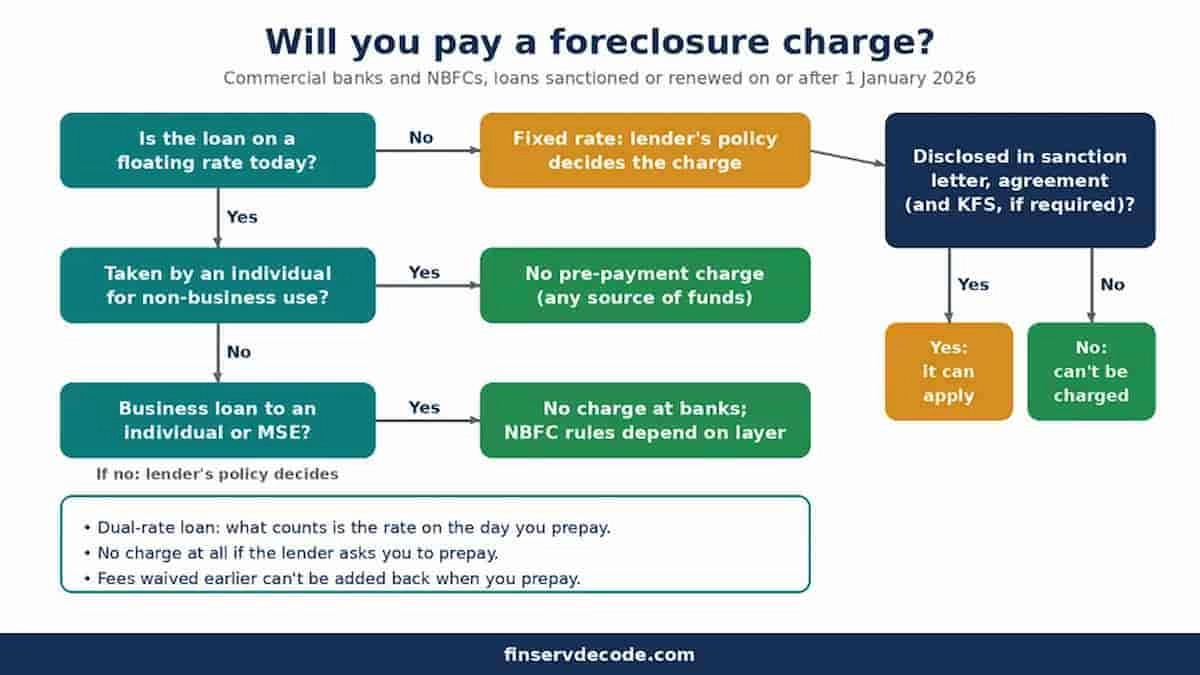
How RBI’s rules decide whether a foreclosure charge can apply to a loan sanctioned or renewed from 1 January 2026. Illustrative graphic created by Finserv Decode.
RBI Guidelines on Foreclosure Charges: New and Existing Loans
The current rules sit in RBI’s Responsible Business Conduct Directions, 2025, which have a separate version for each type of lender. The tables below cover commercial banks and NBFCs.
Small finance banks, payments banks, and local area banks are outside the Commercial Banks directions. Regional rural banks and co-operative banks also have their own RBI directions. So check the version that applies to your lender.
Foreclosure Charges at Commercial Banks
These rules come from the Commercial Banks directions, updated as of 1 October 2026:
| Loan | RBI position |
|---|---|
| Existing floating-rate term loan to an individual for non-business use, sanctioned before 31 December 2025 | No pre-payment charge |
| Floating-rate loan to an individual for non-business use, sanctioned or renewed from 1 January 2026 | No pre-payment charge |
| Floating-rate business loan to an individual or micro/small enterprise (MSE), sanctioned or renewed from 1 January 2026 | No pre-payment charge |
| Dual-rate (fixed + floating) loan | Depends on whether it’s on a floating rate on the day you prepay |
| All other loans, such as fixed-rate loans | As per the bank’s approved policy; for term loans, based on the amount prepaid |
Foreclosure Charges at NBFCs
These rules come from the NBFC directions, updated as of 1 July 2026:
| Loan | RBI position |
|---|---|
| Existing floating-rate term loan to an individual for non-business use, sanctioned or renewed on or before 31 December 2025 | No pre-payment charge |
| Floating-rate loan to an individual for non-business use, sanctioned or renewed from 1 January 2026 | No pre-payment charge |
| Floating-rate business loan to an individual or MSE, from 1 January 2026, by an NBFC in the Upper Layer | No pre-payment charge |
| Same, by an NBFC in the Middle Layer | No charge where the sanctioned amount or limit is up to ₹50 lakh |
| All other loans | As per the NBFC’s approved policy; for term loans, based on the amount prepaid |
Rules That Apply at Both Banks and NBFCs
A few more RBI guidelines on foreclosure charges apply at both types of lenders:
- Source of money doesn’t matter. For the covered loans sanctioned or renewed from 1 January 2026, the no-charge rule applies whether you repay from savings or a new loan, in part or in full.
- Lender-initiated prepayment. If the prepayment happens at the lender’s instance, it can’t levy any charge.
- Disclosure. Whether prepayment charges apply must be stated in the sanction letter and loan agreement, and also in the KFS where a KFS is required for that loan. A charge not disclosed this way can’t be levied.
- No added-back fees. A fee the lender waived earlier can’t be charged retrospectively when you prepay.
Separately, for retail and MSME term loans sanctioned from 1 October 2024, a bank can’t collect any fee that isn’t mentioned in the KFS, at any stage of the loan, without your explicit consent.
Personal Loan Foreclosure Charges: Fixed vs Floating
RBI hasn’t removed personal loan foreclosure charges for every loan. It has removed them for floating-rate personal loans taken by individuals for non-business use. If your personal loan carries a fixed rate, the lender can charge for foreclosure under its approved policy, as long as the charge was disclosed in the required loan documents.
So the first thing to check is the interest type printed in your KFS and sanction letter. For example, say a fixed-rate personal loan has a 4% pre-payment charge under the lender’s policy, and it was properly disclosed. Then you may have to pay it when you foreclose. The 4% here is only an illustration, not a rate set by the RBI.
Home Loan and Car Loan Foreclosure Charges
The same RBI principles apply to home and car loans, but the purpose and the interest type still decide the result:
- Floating-rate home loan: if an individual takes it to buy a home to live in, it’s generally a non-business loan, so it qualifies for the no-charge protection.
- Fixed-rate home or car loan: it can carry a charge under the lender’s approved policy, if disclosed.
- Dual-rate loan: the rate on the day you prepay decides which rule applies.
- Vehicle bought for business use: it may count as a business loan, so check how the lender has classified it.
Lock-In Period: After How Many EMIs Can You Foreclose?
For loans covered by RBI’s new provisions and sanctioned or renewed from 1 January 2026, lenders can’t impose a minimum lock-in period before allowing prepayment. For older floating-rate term loans, RBI separately bars prepayment charges in the cases listed above.
For other loans, such as fixed-rate personal loans, the directions leave it to the lender’s policy and your agreement. If your agreement allows foreclosure only after a set number of EMIs, check whether your loan falls in a covered category before you accept that term.
How to Avoid Foreclosure Charges
- Check your loan papers first. Look at the interest type, the purpose, and the sanction or renewal date in your KFS, sanction letter, and agreement. A covered floating-rate loan can’t carry a charge.
- Question any undisclosed charge. A pre-payment charge that wasn’t disclosed in the documents RBI requires can’t be levied. Raise it in writing with the lender.
- Check for waived fees. A fee the lender waived earlier can’t be added back at foreclosure.
- Read the charge slabs. Some fixed-rate agreements reduce the fee after a set period, in line with the lender’s policy. If yours does, the timing of foreclosure changes the cost.
- Compare part prepayment. If your agreement allows free or cheaper part payments, paying down principal in parts may cost less than one full foreclosure.
- Get the breakdown in writing. Before you pay, ask for a written breakdown of every amount instead of relying on a verbal explanation.
How to Foreclose a Personal, Home or Car Loan
To foreclose a loan, read your loan terms, ask the lender for a foreclosure statement, pay the exact amount before the statement’s validity date, and then collect your closure documents. These steps work for personal, home, and car loans; lenders differ mainly in where you raise the request.
- Check your loan papers. Note the interest type, any foreclosure charge, and any lock-in in your sanction letter, agreement, and KFS.
- Request a foreclosure statement. Use the lender’s app, net banking, email, or branch, as your lender allows.
- Check every line. Compare the charge with your loan papers, and ask in writing about anything you don’t recognise.
- Pay through an official lender channel before the date the statement is valid till, and keep the receipt.
- Get closure confirmation: a closure letter showing zero outstanding, and the NOC or no-dues certificate where the lender issues one.
- Stop the EMI mandate (NACH or standing instruction) once the lender confirms the account is fully closed and no further debit is due.
- Check your credit report after the lender’s next update to the credit bureaus. The account should show as closed, with nothing outstanding.
What Is a Foreclosure Statement?
A foreclosure statement (some lenders call it a foreclosure letter or quote) is the lender’s payoff figure for closing your loan on a given date. It usually shows:
- Principal outstanding after your last EMI
- Interest from the last EMI date to the payment date
- The foreclosure charge, if your loan papers allow one, and any tax on it
- Any unpaid EMI or other dues, and any advance payment or excess balance to be adjusted
- The date until which the figure is valid.
A foreclosure statement isn’t proof that the loan is closed. That comes only from the closure confirmation and no-dues certificate issued after your payment is adjusted. Check the tax line on the statement against your schedule of charges, and ask for corrections before you pay.
Loan Foreclosure Letter Format (Sample Request)
If your lender accepts requests by letter or email, you can adapt this loan foreclosure letter to request a foreclosure statement. Replace the parts in brackets.
To,
The Branch Manager / Loan Servicing Team
[Lender name], [Branch or address]
Date: [DD Month YYYY]
Subject: Request for foreclosure statement – Loan account no. [number]
Dear Sir/Madam,
I have a [personal/home/car] loan with you under loan account number [number], taken on [date]. I would like to foreclose this loan and repay the full outstanding amount.
Please send me a foreclosure statement showing the outstanding principal, interest up to the payment date, any foreclosure charges and taxes as per my loan documents, and the date until which the amount is valid. Please also confirm the payment modes I can use.
After the payment has been received and adjusted, kindly confirm that the loan account is fully closed, issue the no-dues certificate or NOC and closure letter, and confirm cancellation of the EMI mandate.
[For a secured loan: Please also return my original property documents and remove the charge registered on them.]
Thank you.
[Your name]
[Registered mobile number] | [Email]
[Signature]
After Payment: NOC, Mandate and Property Papers
Keep the closure letter, NOC or no-dues certificate, payment receipt, and final statement together.
For a personal loan secured by property, RBI requires banks and NBFCs to release the original documents and remove charges registered with any registry within 30 days after full repayment or settlement. This comes from the Commercial Banks directions and the matching NBFC provision.
If the delay is the lender’s fault, it must pay you ₹5,000 for each day beyond those 30 days. If the originals are lost or damaged, the lender must help you get duplicate or certified copies and bear the cost; in that case, it gets 30 more days before the daily compensation is counted.
Where the lender had registered its security interest with CERSAI, check that it has been removed. This guide on how CERSAI records and removes a lender’s charge explains the process.
How the Loan Foreclosure Amount Is Calculated
Foreclosure amount = principal outstanding + interest since the last EMI + foreclosure charge (if allowed) + tax on the charge (if any) + any unpaid dues.
Your savings are the interest you’d otherwise pay over the rest of the tenure, minus the charge and other foreclosure costs.
Here’s a worked example. The figures were calculated on a reducing-balance basis and rounded to the rupee:
- Personal loan of ₹5,00,000 at 13% fixed, 36 monthly EMIs, sanctioned after 1 January 2026
- EMI: ₹16,847
- A 4% foreclosure charge on the amount prepaid is assumed for illustration; it isn’t an RBI-fixed rate or a standard charge
- The payment is made right after an EMI is posted, so extra accrued interest is left out
- Tax on the charge and other lender fees are excluded
| Item | Foreclose after 12 EMIs | Foreclose after 30 EMIs |
|---|---|---|
| Principal outstanding | ₹3,54,361 | ₹97,357 |
| 4% foreclosure charge | ₹14,174 | ₹3,894 |
| Amount to pay now | ₹3,68,535 | ₹1,01,251 |
| Remaining EMIs if you don’t foreclose | 24 × ₹16,847 = ₹4,04,327 | 6 × ₹16,847 = ₹1,01,082 |
| Interest avoided (remaining EMIs − principal outstanding) | ₹49,966 | ₹3,725 |
| Net result (interest avoided − charge) | You save ₹35,792 | You pay ₹169 more |
Why such a big difference? In a reducing-balance EMI loan, the interest part of each EMI is higher in the early instalments. So repaying the principal early avoids more future interest. Near the end of the tenure, little interest is left, and a percentage charge can wipe out the savings. The real saving always depends on the remaining tenure, the rate, and the foreclosure costs.
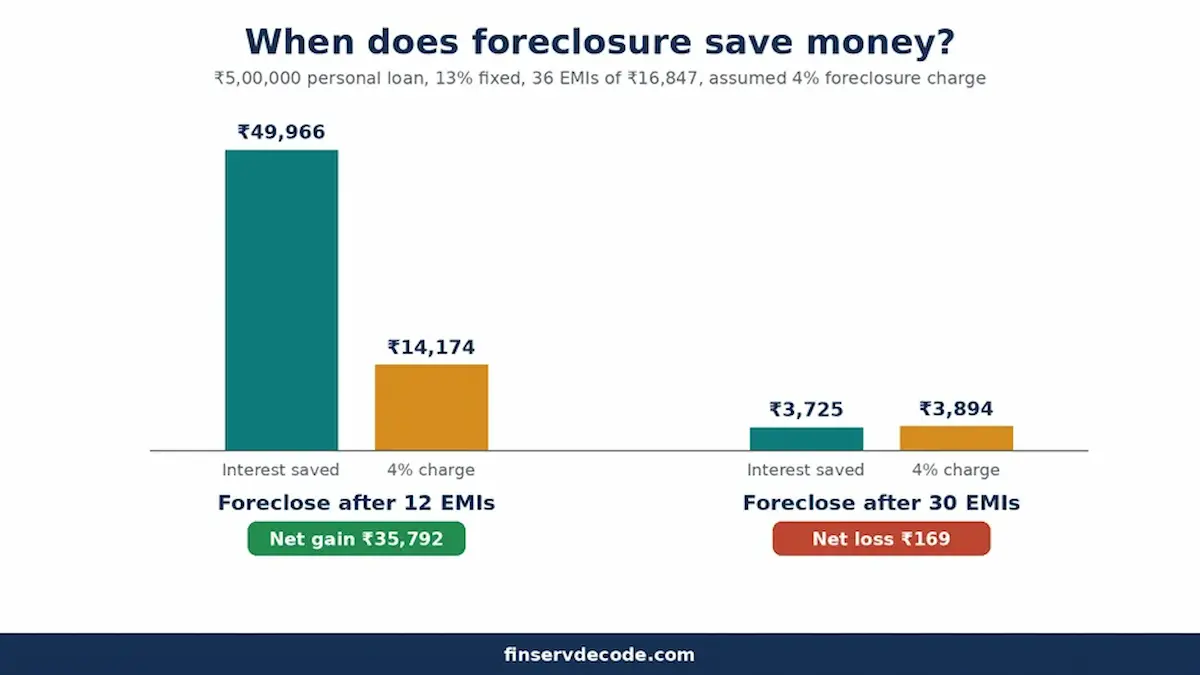
With an assumed 4% charge, foreclosing after 12 EMIs saves ₹35,792; after 30 EMIs, it costs ₹169 more (taxes excluded). Illustrative graphic created by Finserv Decode.
Foreclosure vs Part Prepayment
Part prepayment reduces your principal while the loan continues; foreclosure ends the loan. Part prepayment suits you when you have some spare money but not the full balance, or when you want to keep cash for emergencies.
Take the same loan as above. After 12 EMIs, you part-prepay ₹1,00,000, leaving ₹2,54,361 outstanding:
| Option | Effect | Interest saved (before any charge) |
|---|---|---|
| Keep EMI at ₹16,847 | Tenure falls from 24 to about 17 months | About ₹25,051 |
| Keep tenure at 24 months | EMI falls to about ₹12,093 | About ₹14,100 |
| Foreclose the full ₹3,54,361 | Loan closes now | ₹49,966 |
On a covered floating-rate loan, part prepayment carries no charge. On a fixed-rate loan, the lender’s policy may allow a charge on part payments too: at an assumed 4%, a ₹1,00,000 part payment would cost ₹4,000, before any tax.
Keeping the EMI and cutting the tenure saves more interest, while lowering the EMI eases your monthly budget. Before you use spare cash, work out how much you can put towards the loan without touching your emergency savings; the 50/30/20 budgeting rule can help.
Is Loan Foreclosure Good or Bad?
Foreclosure is good when it saves more interest than it costs and doesn’t leave you short of cash. It’s a poor choice when the charge eats the savings, or when using the money leaves you without a cushion. This table is general guidance, not a rule from RBI:
| Foreclosure tends to make sense when | Think twice when |
|---|---|
| You’re early in the tenure, so most interest is still ahead | Only a few EMIs are left, and a charge applies |
| The loan is a covered floating-rate loan, so no charge applies | The charge is more than the interest you’d save |
| You still keep an emergency fund after paying | Paying would leave you with no savings for emergencies |
| You have no costlier debt to deal with first | You carry a credit card balance or other higher-cost debt |
| The EMI is straining your monthly budget | The money is set aside for a large expense you expect soon |
If you carry high-interest credit card debt, compare its cost with the loan’s interest and foreclosure charge before you decide where your spare money goes. Here’s how credit card interest is calculated. A heavy EMI also raises the risk of missing a payment, which can hurt your credit far more than closing a loan.
Loan Foreclosure FAQs
Will my CIBIL score drop if I foreclose a loan?
Foreclosure means you repay the full amount, so the account is generally reported as closed, not settled or written off. Your score can still move after an account closes, and earlier late payments stay in your history. Here’s why your credit score can dip after you pay off a loan.
Can a lender charge a fee that isn’t in my KFS?
Not a pre-payment charge that wasn’t disclosed in the sanction letter, the loan agreement and, where required, the KFS. For retail and MSME term loans from 1 October 2024, banks also can’t collect any fee missing from the KFS without your explicit consent. Raise it in writing with the lender.
Can I foreclose using money from a new loan or a balance transfer?
Yes. For the covered floating-rate loans sanctioned or renewed from 1 January 2026, no charge applies, whatever the source of the money. For a fixed-rate loan, any properly disclosed charge applies whether you use savings or a new loan.
What if the lender asks me to close the loan?
Then it can’t levy any prepayment charge. Under both the bank and NBFC directions, no charge applies when the prepayment happens at the lender’s instance.
Is foreclosure the same as loan settlement?
No. In foreclosure, you pay the full outstanding amount, and the account is closed in full. In settlement, the lender accepts less than the full dues, and the account is reported as settled.
How long does the lender take to return property papers?
For a personal loan secured by property, banks and NBFCs must return the originals and remove registered charges within 30 days of full repayment or settlement. A delay that’s the lender’s fault costs it ₹5,000 a day; for lost or damaged papers, it gets 30 extra days to arrange certified copies first.
What is the foreclosure meaning in Hindi?
In Hindi, loan foreclosure is usually described as समय से पहले लोन बंद करना (samay se pehle loan band karna). It means paying off the full remaining loan in one go before the tenure ends.
Conclusion
Before you foreclose, check your KFS, sanction letter, and loan agreement. Confirm whether the loan is fixed or floating, whether it falls in RBI’s no-charge categories, and what amount the lender is asking for. If it’s a covered floating-rate loan, no pre-payment charge can be levied. For other loans, compare the charge with the interest you’d still pay: loan foreclosure early in the tenure usually saves the most, while foreclosing near the end can cost more than it saves.
If you go ahead, get a dated foreclosure statement, pay through an official lender channel, and keep the receipt. Then wait for the lender to confirm the account is fully closed, collect the NOC or no-dues certificate, and check that your credit report shows the closure.
Disclaimer
This article gives general information about loan foreclosure and RBI’s rules on pre-payment charges. It isn’t financial or legal advice. RBI’s directions differ by type of lender and by the loan’s sanction date, so check the provisions that apply to your lender and the documents issued for your loan. The worked examples use assumed figures and leave out taxes and other fees.