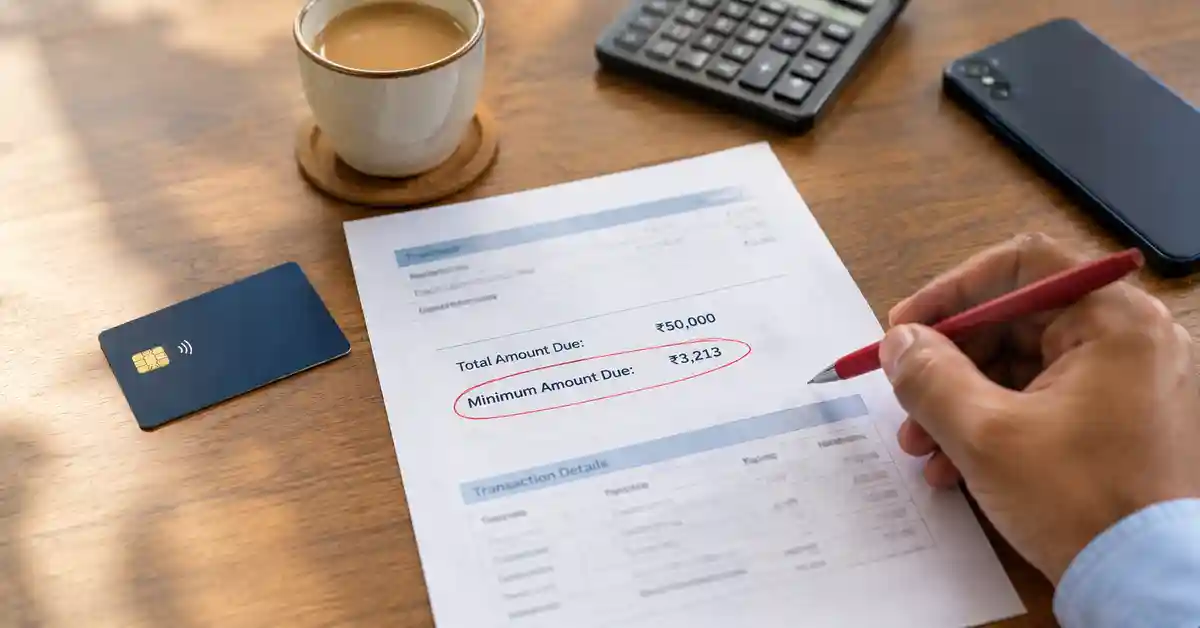
The minimum due in credit card is the smallest amount you must pay by the due date to avoid a late fee. It’s also called the minimum amount due (MAD). Paying it keeps your account in good standing, but interest is still charged on the rest of your bill.
Your statement shows two numbers side by side: the total amount due and a much smaller minimum due. Paying the smaller one feels easy. This article explains what that choice costs, how SBI Card works out the minimum, and how to get out if you’re already paying only the minimum every month.
What Is the Minimum Due in Credit Card?
The credit card minimum due is the least your bank will accept for that month without treating the payment as missed. When you pay it on time:
- You don’t pay a late fee.
- Your payment isn’t reported as late to credit bureaus.
What it doesn’t do:
- It doesn’t stop interest on the unpaid part of your bill.
- It doesn’t keep your interest-free period. New purchases also start collecting interest until the full balance is cleared.
So the minimum due is not a discount and not a repayment plan. It’s only the lowest payment that keeps a late fee away.
Where to Find the Minimum Due on Your Statement
Every credit card statement shows a few terms together near the top. People often mix them up, so here’s what each one means:
| Term on Statement | What It Means |
|---|---|
| Total Amount Due | Your full bill for the month. Pay this to avoid interest. |
| Minimum Amount Due | The smallest payment that avoids a late fee. |
| Outstanding Balance | Everything you owe on the card right now, including purchases made after the statement. |
| Statement Date | The day your bill is made each month. |
| Payment Due Date | The last day to pay without a late fee. |
You can also see the minimum due in your bank’s app and in the SMS or email sent with each statement.
Minimum Due vs Total Due: What’s the Difference?
| Factors | Minimum Amount Due | Total Amount Due |
|---|---|---|
| What it is | The smallest payment the bank accepts for the month | Your full bill for the month |
| Avoids late fee | Yes | Yes |
| Avoids interest | No | Yes, if paid in full by the due date |
| Interest-free period on new purchases | Lost until the balance is cleared | Stays |
| Effect on your balance | Most of it carries forward | Cleared |
You can also pay any amount in between. The more you pay, the less is left to collect interest.
How Is Minimum Amount Due Calculated?
There’s no single formula for all banks. Most banks build the minimum due from two kinds of amounts:
- Amounts you must pay in full. These usually include any EMI due that month, fees, GST, and any amount spent over your credit limit.
- A share of your remaining balance. Many cards use a percentage of the balance, often around 5%.
Some banks also set a small fixed minimum for low balances. The exact formula is in your card’s MITC, and it can change over time.
SBI Minimum Amount Due Formula
SBI Card changed its formula on 15 July 2025. As per SBI Card’s key fact statement, the SBI minimum amount due is now the total of:
- 100% of GST
- 100% of any EMI due that month
- 100% of fees
- 100% of finance charges (interest)
- Any amount over your credit limit
- 2% of the remaining balance
The 2% often confuses people. It doesn’t mean your minimum due is 2% of your bill. The 2% is added after all the interest, fees, GST, and EMIs are counted in full.
SBI Minimum Due on a ₹50,000 Balance Calculation
Suppose you carried ₹50,000 from last month, and this month’s statement adds one month of interest at 3.75%:
| Part of Minimum Due | Amount |
|---|---|
| Interest (3.75% of ₹50,000) | ₹1,875 |
| GST on interest (18%) | ₹338 |
| 2% of remaining balance (₹50,000) | ₹1,000 |
| Minimum amount due | ₹3,213 |
You pay ₹3,213, but only ₹1,000 of it reduces what you owe. The other ₹2,213 is interest and tax.
Why Interest Continues Even After You Pay the Minimum
A credit card gives you an interest-free period only when you pay the full bill. Once you pay less than the total amount due, two things change:
- Interest is charged on your purchases from the date of each purchase, not from the due date.
- New purchases also collect interest from the day you make them, until the whole balance is cleared.
Here’s a simple timeline:
- 5 September: Your statement is made. Total due is ₹20,000 and minimum due is ₹1,000.
- 25 September: You pay ₹1,000. No late fee is charged.
- 28 September: You buy something for ₹5,000. Normally, this would be interest-free until the next due date. Now it collects interest from 28 September.
- 5 October: Your next statement shows interest on the old balance and on the new purchase, plus GST on that interest.
If you’re not sure how the billing cycle and due date work, it helps to go through them once with your own statement.
Minimum Due Interest: What Paying Only the Minimum Costs
Suppose your bill is ₹20,000, and you pay a ₹1,000 minimum. If the remaining ₹19,000 stays unpaid for a month at 3.75%, the minimum due interest is about ₹713, plus ₹128 GST. That’s around ₹841 for one month. The real figure is usually a little higher, because banks count interest from the date of each purchase. You can see how that daily interest is counted with a full example.
Month-after-month calculation
Here’s what happens to a ₹50,000 balance on SBI’s formula if you stop using the card and pay only the minimum every month:
| Time | Balance Left | Interest and GST Paid Till Then |
|---|---|---|
| 1 year | ₹39,236 | ₹23,816 |
| 3 years | ₹24,161 | ₹57,170 |
| 5 years | ₹14,878 | ₹77,708 |
| 10 years | ₹4,427 | ₹1,00,830 |
In the first year, you pay about ₹34,580 in total, and only ₹10,764 of that reduces your debt. After 10 years, the interest and GST paid are double the amount you originally owed, and the balance still isn’t zero.
This example assumes 3.75% monthly interest, 18% GST on interest, no new spending, and no other fees. It uses simple monthly interest to keep the maths clear. Your real numbers depend on your card’s rate and formula.
What Happens If You Miss the Minimum Due?
Missing the minimum payment on credit card bills costs more than paying it:
- Late fee. SBI Card charges ₹100 on dues of ₹101 to ₹500, ₹500 on dues of ₹501 to ₹1,000, and up to ₹1,300 on dues above ₹50,000, plus GST, as per its late payment charges notice.
- Extra charge. SBI Card can add ₹100 more if you miss the minimum due two billing cycles in a row.
- Credit report. Under RBI’s credit and debit card directions for banks, a bank can report you as late, or charge a late fee, only when the payment is more than 3 days past the due date. Interest can still apply for those days.
Late fees are only one part of the cost. Interest, GST, and other fees add up, so it helps to know what each fee can add to your bill.
Minimum Due Effect on CIBIL Score
The minimum due effect on CIBIL score has two sides:
- Payment history stays clean. Paying the minimum on time means no late payment is reported.
- Credit usage stays high. If you owe ₹1,00,000 on a ₹1,50,000 limit and pay only the minimum, you’re still using about two-thirds of your limit. High usage over many months can pull your score down, even with no missed payments.
Many lenders prefer usage around 30% of the limit or lower, though there’s no fixed official cut-off. Paying more than the minimum lowers usage.
Advantages and Disadvantages of Minimum Due
Advantages
- No late payment fee for that month
- Payment isn’t reported as late to credit bureaus
- Gives you time in a short cash crunch
- Your card stays active and usable
Disadvantages
- Interest is charged on the unpaid balance
- 18% GST is added to that interest
- New purchases lose the interest-free period
- The balance comes down very slowly
- Credit usage stays high, which can lower your CIBIL score
- You can end up paying more in interest than you first owed
The advantages last for one month. The disadvantages grow every month the balance stays unpaid.
When Paying Only the Minimum Can Make Sense
Paying the minimum is better than paying nothing. It can be a fair choice when:
- Your salary is delayed, or you have a one-time emergency, and you can clear the bill within a month or two.
- Missing the payment fully is the only other option.
It becomes a problem when it turns into a monthly habit, especially if you keep spending on the same card.
What to Do If You Can’t Pay the Full Bill
| Option | How It Helps | What to Check First |
|---|---|---|
| Pay only the minimum | Avoids the late fee this month | Interest and GST continue on the rest |
| Pay a fixed amount above the minimum | Clears the balance much faster | Pick an amount you can keep paying every month |
| Convert the balance to EMI | Usually a lower interest rate, with a fixed end date | Processing fee, GST, and foreclosure charges |
| Balance transfer to another card | Lower rate for a limited period | Transfer fee and the rate after the offer ends |
Compare the total cost of each option before you choose. Your bank’s app or customer care can give you the exact EMI rate and fees for your card.
How to Avoid the Minimum Due Trap
Before it starts
- Treat the minimum due as a backup, not your normal payment. Plan to pay the total amount due every month.
- Set auto-pay for the full amount. If that isn’t possible, set it for the minimum so you never miss the due date, and pay the rest yourself.
- Spend only what you can clear from your next salary. Your credit limit isn’t your budget.
- Check your statement as soon as it arrives. You get more time to arrange the full amount.
Don’t use the card for ATM cash. Cash collects interest from the first day and makes the bill harder to clear.
If you’re already paying only the minimum
- Stop new spending on that card. New purchases collect interest from day one while a balance is carried.
- Make a monthly payment above the minimum. Even the first month’s minimum, paid every month, clears the balance far sooner.
- Ask about converting the balance to EMI. Check the processing fee, GST, and foreclosure charges first.
- Look at a balance transfer. Compare the transfer fee with the interest you’d save.
Common Myths About Minimum Due
| Myth | Fact |
|---|---|
| Paying the minimum due means no interest | Interest is still charged on the unpaid balance |
| The minimum due is always 5% of the bill | Each bank has its own formula. SBI Card uses full interest, fees, and GST, plus 2% of the balance |
| The minimum due is the same as the EMI | An EMI is a fixed instalment. The minimum due includes any EMI plus other amounts |
| Paying the minimum every month is good for my score | It protects payment history, but high usage can still lower the score |
| A lower minimum due next month means I'm doing well | It falls because the balance fell slightly. Most of the debt is still there |
What Does No Minimum Due Mean?
If your statement shows ₹0 or “No Minimum Due”, no payment is required for that month. This usually happens when you’ve already cleared your balance, or your account has a credit balance. Still, check the total amount due. If it shows any amount, pay it by the due date to avoid interest.
RBI Rules That Protect You
RBI’s card directions for banks include a few rules that matter here:
- A 3-day buffer. A late fee or a late report is allowed only when the payment is more than 3 days past the due date.
- A warning on your statement. Banks have to tell cardholders that paying only the minimum stretches repayment and adds interest.
- Clear terms upfront. The bank must share the MITC, including how the minimum due is calculated, before you accept a card.
- A way to complain. If you think a charge is wrong, raise it with your bank first. If it isn’t resolved within 30 days, you can file a complaint on RBI’s complaint management portal.
Minimum Due in Credit Card Meaning in Hindi
क्रेडिट कार्ड में मिनिमम ड्यू (Minimum Amount Due) वह सबसे छोटी रकम है जो आपको ड्यू डेट तक चुकानी होती है, ताकि लेट फीस न लगे और आपकी पेमेंट लेट रिपोर्ट न हो।
लेकिन सिर्फ मिनिमम ड्यू भरने से बाकी बचे बैलेंस पर ब्याज लगता रहता है, और उस ब्याज पर 18% GST भी लगता है। नई खरीदारी पर भी ब्याज-मुक्त अवधि नहीं मिलती।
उदाहरण के लिए, SBI कार्ड पर ₹50,000 के बकाया पर पहले महीने का मिनिमम ड्यू लगभग ₹3,213 बनता है, जिसमें से सिर्फ ₹1,000 आपका कर्ज़ घटाता है। बाकी रकम ब्याज और टैक्स में जाती है। इसलिए जब भी हो सके, पूरा Total Amount Due चुकाएं।
FAQs: Minimum Due in Credit Card
What is minimum due in credit card?
It’s the smallest amount you must pay by the due date to avoid a late fee and a late payment report. Interest still applies to the rest of your bill.
What happens if I pay only the minimum due every month?
You avoid the late fee, but interest and GST keep adding up on the unpaid balance. Over time, you can pay more in interest than the amount you originally owed.
Does paying the minimum due stop interest?
No. Interest is charged on the unpaid balance, and new purchases also lose their interest-free period until you clear the full amount.
Is minimum due the same as EMI?
No. An EMI is a fixed instalment for a purchase you converted. The minimum due is the least you must pay on your whole bill, and it includes any EMI due that month.
Can I pay more than the minimum but less than the total?
Yes. You can pay any amount between the two. Interest then applies only to what’s left, so paying more lowers your cost.
Is the minimum due the same at every bank?
No. Each bank sets its own formula, and it can change. SBI Card revised its formula in July 2025. Check your own card’s MITC.
Does minimum due affect my CIBIL score?
Paying it on time protects your payment history. But carrying a large balance keeps your credit usage high, which can lower your score over time.
Conclusion
The minimum due keeps a late fee away for one month. It doesn’t reduce what you owe by much, and interest keeps running on the rest. Use it only as a short-term fallback, pay the full amount whenever you can, and if you’re already carrying a balance, stop spending on that card and pay more than the minimum each month.
If you’re new to cards, it helps to understand how the billing cycle and due date work before your next statement arrives.
Disclaimer: This article is for general information and education only. It is not financial advice. FinServ Decode is not a bank or card issuer.
SBI Card figures were checked as of now from SBI Card’s official documents. Banks can change formulas, fees, and interest rates at any time. The examples here are simple illustrations based on stated assumptions and are not a projection for any card or account. Check your own statement and your card’s latest MITC for the numbers that apply to you.